Check Czech documents, mileage, export and German registration: plan your private car purchase, transport, VAT treatment and costs.
Before paying a deposit, check the vehicle’s identity, the seller’s authority to sell, original documents, mileage records and condition. Then agree the export route and transport arrangements, and establish what evidence German registration requires. This advice is for private buyers resident in Germany purchasing a used passenger car already registered in Czechia. A location in Czechia alone proves neither that the car has Czech documents nor where it has previously been used.
If you are still comparing countries to buy from, our guides to buying a car abroad (in German) outline other sourcing options for buyers in Germany.
Check the seller and original documents before committing
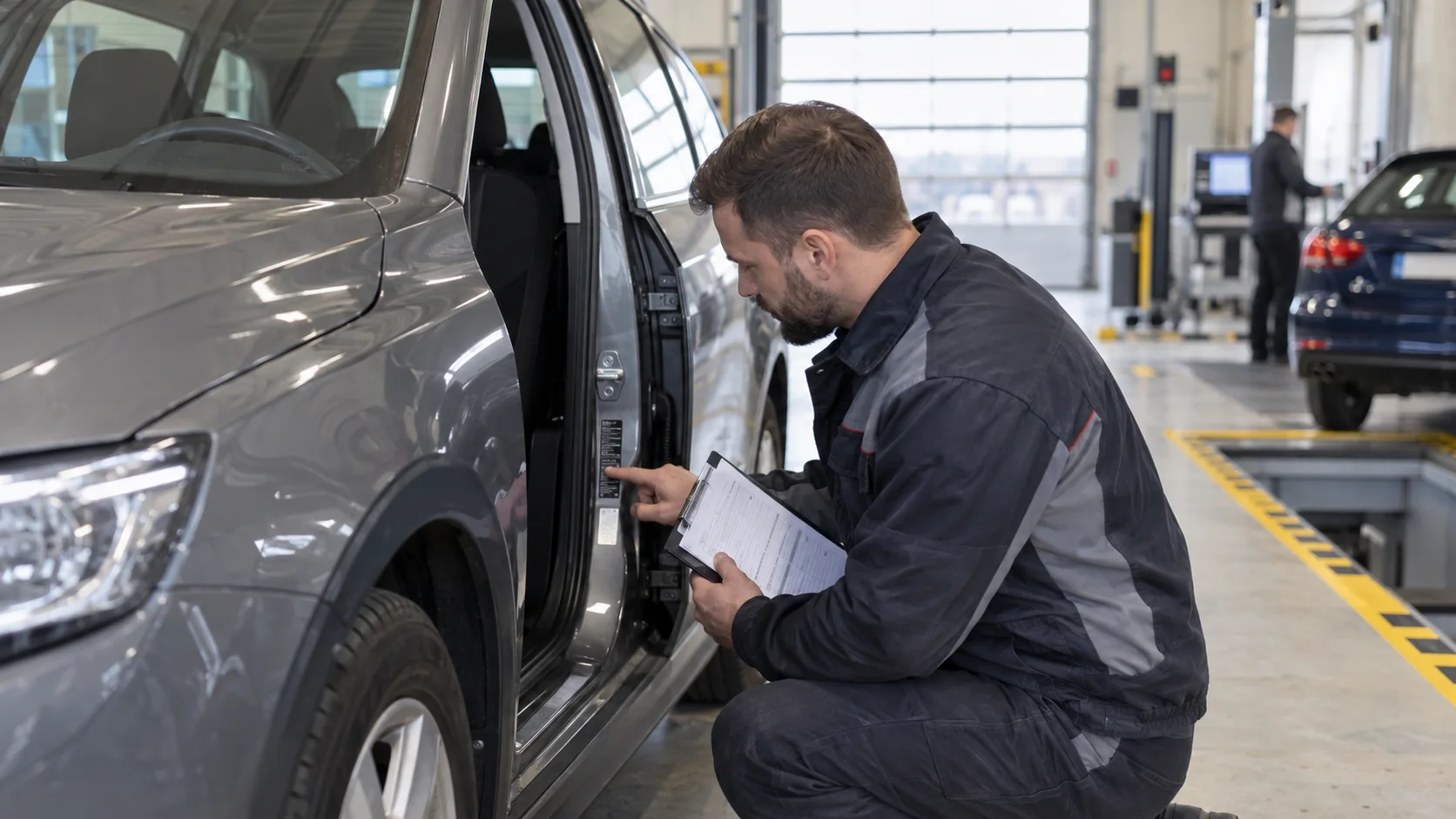
Ask for the vehicle identification number (VIN, known as FIN in German), photographs of the documents, the date of first use, the mileage and service records. At the car, compare the VIN with the originals and the contract. Check the seller’s identity and authority to sell: where company representatives, joint ownership, finance or leasing are involved, obtain clear evidence of the owner’s consent and the representative’s authority. Possession of the keys alone does not prove the right to sell. Record damage, mileage assurances, missing documents, keys, payment and handover arrangements in writing. Establish seller status and your contractual rights before signing; living in Germany does not automatically make all German statutory warranty rules apply to the purchase. 1 17
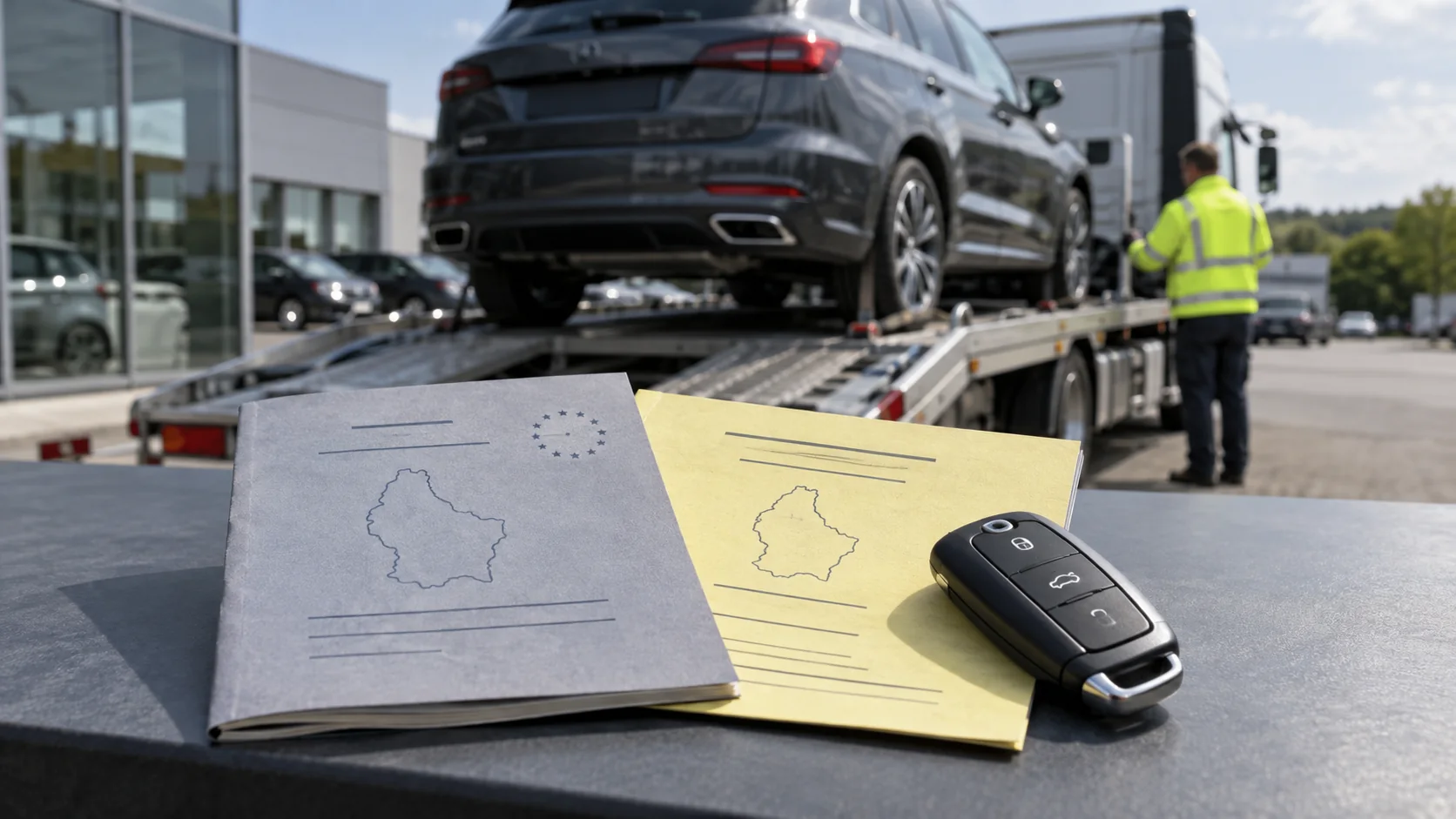
Since 1 January 2024, Czechia has issued a single registration certificate: the osvědčení o registraci vozidla (ORV). Older lawful sets comprising a registration certificate and the technical vehicle document, the technický průkaz, remain valid until replaced during a registration procedure. Do not therefore insist on a new issue of the former large technical document in every case. Establish which generation of documents the car has and which originals you will receive. 2
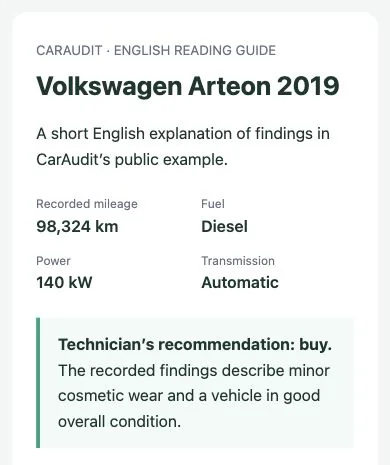
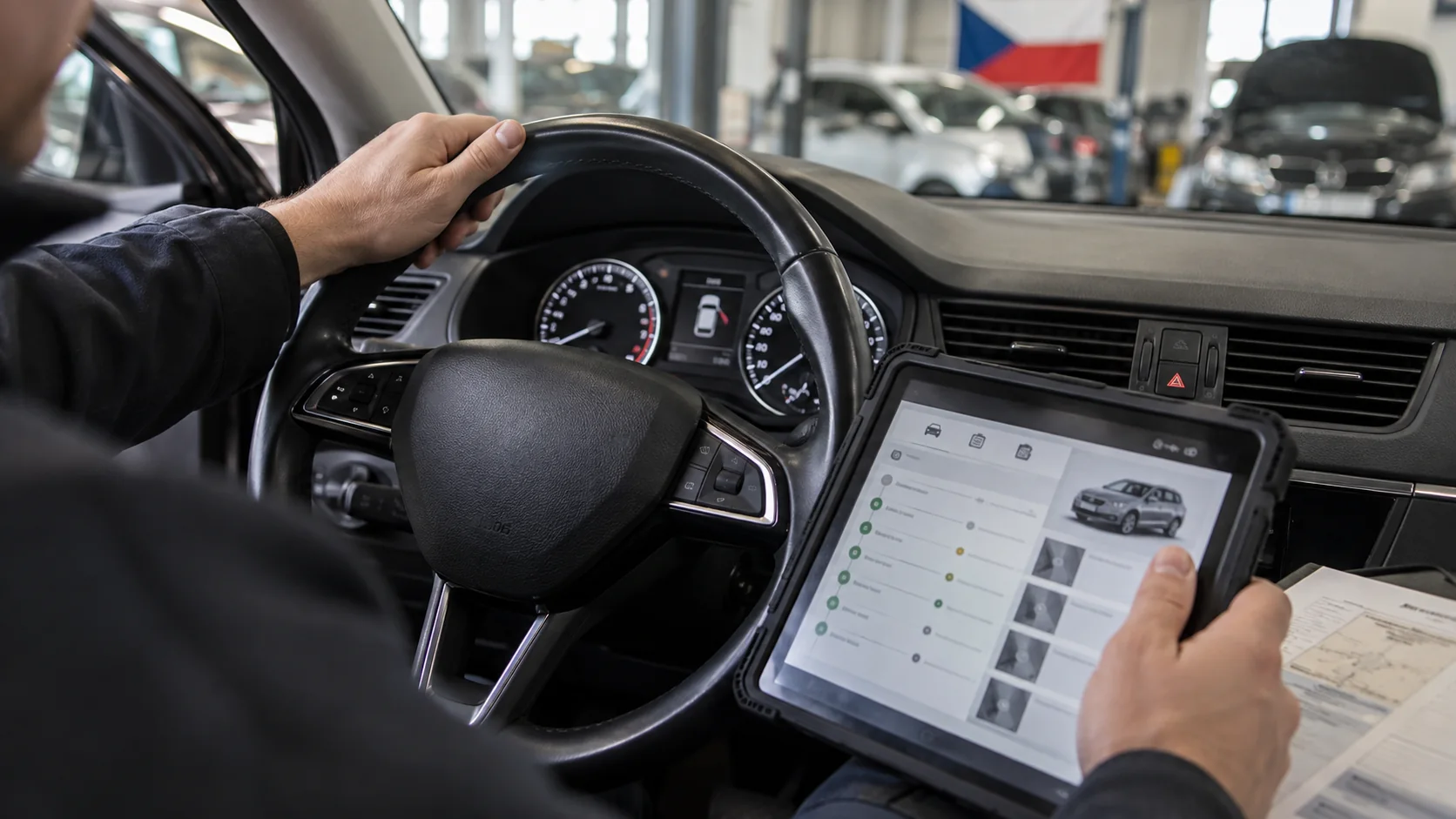
Editorial English reading guide: Volkswagen Arteon 2019, 98,324 km, 140 kW, diesel, automatic.
Editorial English reading guide to the public example. Original: English navigation and Spanish technician notes; not the reader’s vehicle. The guide is an editorial presentation, not a provider report fully localised into English.
Assess the mileage sequence alongside the car’s current condition
Enter the VIN in Kontrola tachometru. This Ministry of Transport service shows readings recorded at technical inspections and emissions tests. STK stands for stanice technické kontroly, a Czech vehicle inspection station. The stored readings may not reflect the car’s true current total mileage. They provide neither a complete vehicle history nor proof of ownership. 3
Compare the dated sequence with invoices and the current odometer reading. A gap leaves that period unproven; falling readings require supporting evidence, for example of an instrument replacement. A decrease alone is not legal proof of fraud. Rising readings do not establish the full mileage or prove that the car is accident-free either. If the car was previously abroad, ask for records from that period. If you are considering an alternative offer in Poland, our guide to buying a car in Poland (in German) will help you prepare its document and history checks.
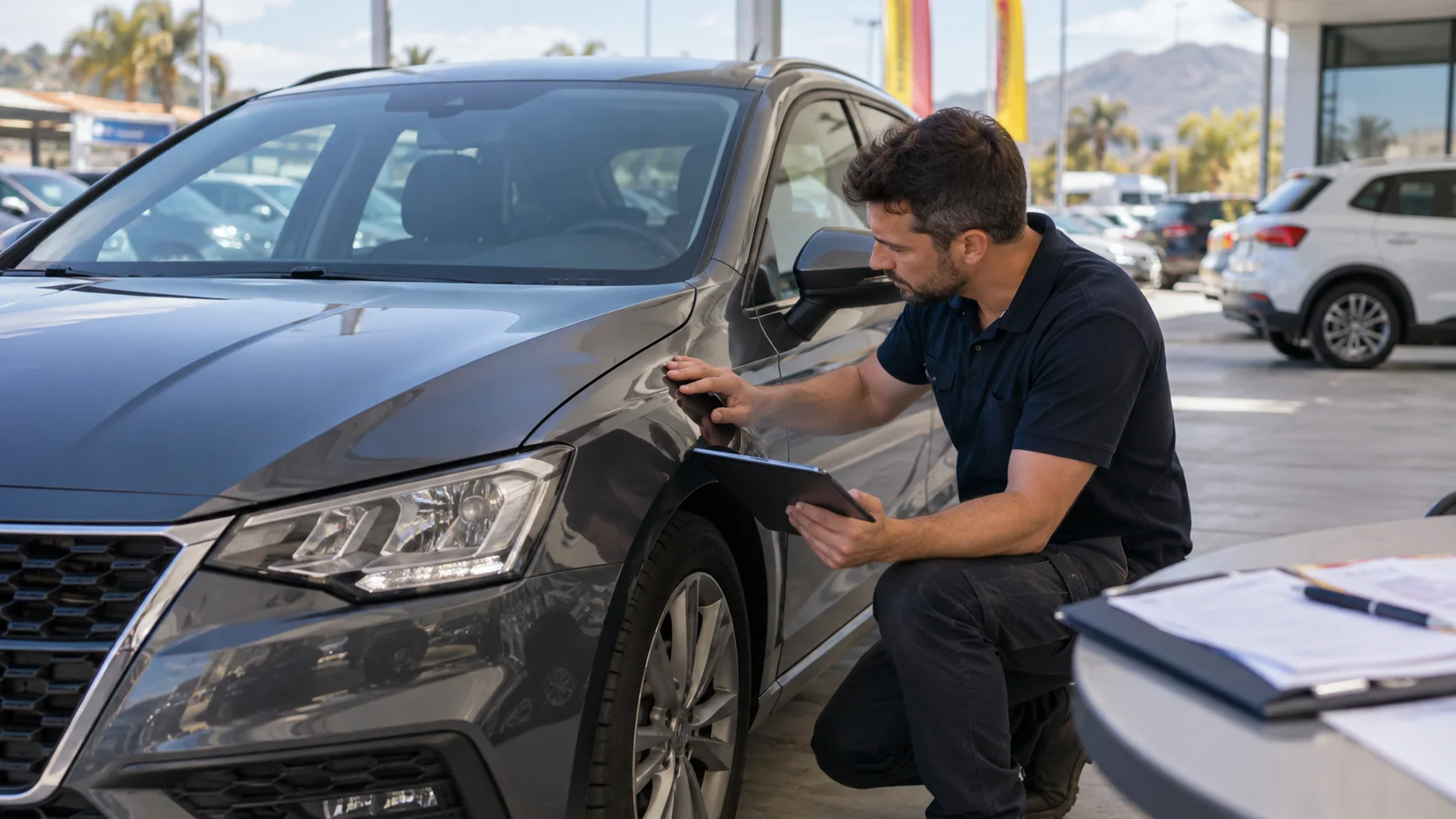
Have the bodywork, repair quality, underbody, brakes, tyres, suspension, engine and gearbox inspected. Arrange a cold start, diagnostic checks and a lawful test drive; compare the findings with the seller’s statements. Obtain specific quotes for upcoming repairs before assessing the purchase price. 4
| Finding | Next step before paying |
|---|---|
| VIN, owner or originals do not match | Obtain evidence of authority and documents. |
| Mileage sequence has gaps or falling readings | Request original records and an explanation. |
| Wear or repairs identified | Assess the findings and obtain a repair quote. |
| Documents are plausible and condition is established | Firmly agree export, handover and transport arrangements. |
Agree the export route and collection before paying
The Ministry of Transport lists two administrative routes for export within the European Union (EU): apply for export plates with limited validity, or subsequently register the vehicle in the other EU country. In the second case, that country’s authority notifies Czechia of the completed registration within two months. This route depends on actual EU registration taking place. The two months are an authority’s notification deadline after registration, not a buyer’s registration deadline or permission to drive or insurance cover. Coordinate the notification and the car’s Czech register status. 1
For export plates, the registered owner applies at any competent ORP: an obecní úřad obce s rozšířenou působností, a municipal authority with extended powers. A representative needs written power of attorney bearing the owner’s officially certified signature. Agree in advance who will apply. 1
The documents required are the application, unless submitted online, original identification, the registration certificate, the technical vehicle document if issued, and all issued number plates for surrender. Companies must also provide original or certified copies of trade or company register documents; representatives need the relevant power of attorney. The authority checks that there is a valid evidenční kontrola: an inspection matching the vehicle’s identity and data. This vehicle check is separate from checking the applicant’s identification and from a pre-purchase condition inspection. 1
Even after applying online through Portál dopravy, the original documents and existing plates must be taken to the chosen authority. Check electronic access with the applicant; a German buyer cannot assume access simply on the basis of residence. The authority sets the plates’ actual validity, up to a maximum of three months. They are issued without delay, usually during the visit; more complex cases are usually handled within 30 days. Explicitly allow for the appointment and collection. 1
Drive the car yourself or carry it on a transporter?
Before driving, confirm the validity of the plates and registration, the car’s roadworthiness and insurance for the entire route and travel dates. Obtain confirmation of cover from the insurer instead of assuming that the seller’s policy continues after the sale or a change in status. If a lawful, safe journey is not established, obtain a quote for carrying the car on a transporter. Coordinate payment and the handover of the car, keys and originals.
| Option | Establish before booking |
|---|---|
| Driving the car yourself | Confirm valid registration and plates, roadworthiness, and insurance for the route and travel dates. |
| Carriage on a vehicle transporter | Agree the price, collection location and date, and handover of the car, keys and original documents. |
Sources: 1
German registration: documents and technical evidence
Send copies of the vehicle documents to your competent registration authority before committing to the purchase. It will commonly require the original foreign documents, existing plates, the purchase contract or invoice, proof of identity, an application, electronic insurance confirmation (elektronische Versicherungsbestätigung, eVB), a Single Euro Payments Area (SEPA) direct debit mandate for German motor vehicle tax, and the required inspection evidence. Additional requirements depend on the local authority and the car. 10
For type-approved vehicles, the European Community (EC) Certificate of Conformity (CoC) or manufacturer data serve as technical evidence; Berlin lists both options. A missing CoC alone therefore does not automatically require an expert report under section 21 of the German Road Traffic Licensing Regulations (Straßenverkehrs-Zulassungs-Ordnung, StVZO). Without type approval, that expert-report route is required. 18
If Part II of a genuinely two-part foreign registration certificate is missing, section 8 of the German Vehicle Registration Ordinance (Fahrzeug-Zulassungsverordnung, FZV) requires confirmation from the foreign authority via Germany’s Federal Motor Transport Authority (Kraftfahrt-Bundesamt, KBA). This differs from a lawful single new Czech document. 11
When can the Czech inspection report be sufficient?
For an EU-type-approved vehicle previously used in the EU or the European Economic Area (EEA), section 8 FZV considers whether a German periodic roadworthiness inspection (Hauptuntersuchung, HU) would already be due under German intervals. For an ordinary privately used passenger car, the first inspection is after 36 months and subsequent inspections every 24 months; special uses have different intervals. 16
If an inspection would be due, an inspection under section 29 StVZO is generally required. A proven qualifying inspection under Directive 2014/45/EU from the EU/EEA country where the vehicle was previously used can replace it. The next due date then follows German intervals. Have the specific inspection report, its date and proof of first use checked. If proof of first use is missing, the section 29 inspection is required. Previous use outside the EU/EEA falls under the separate rule requiring a section 29 inspection. A Czech STK report is therefore not automatically accepted in every case. 11
Berlin notifies the country of origin of a registration, but does not promise automatic Czech deregistration. Coordinate the notification with the chosen Czech EU-export route and check the register status. 18 1
Establish VAT treatment and your budget before signing
For value added tax (VAT), a vehicle is new if, at acquisition, it has covered no more than 6,000 km or no more than six months have elapsed since first use. It is used only if it has covered more than 6,000 km and more than six months have elapsed. A car that is already registered can therefore still be new for tax purposes. A German private buyer pays German VAT at 19% on an intra-EU acquisition of a vehicle that is new for tax purposes. Clarify the taxable amount, declaration and payment with the tax office before buying. 8 9 17
A private sale of a vehicle that is used for tax purposes carries no VAT on the sale. With a dealer, distinguish seller status from invoice type: ordinary VAT treatment or the margin scheme. VAT may or may not be shown separately; the absence of a separate VAT amount alone does not establish the scheme. Crossing the border creates neither automatic German acquisition VAT nor a right to buy net of VAT. No customs duty is payable on an ordinary transfer from Czechia to Germany. 17
| Item | Amount | Conditions and how to establish the cost |
|---|---|---|
| Purchase price, seller status and invoice type | To be established | Clarify the contract, seller status, invoice type and payment currency; obtain the exchange rate and charges. |
| German basic registration/re-registration fee | EUR 30.00 | Basic fee under the German Road Traffic Fees Regulations (Gebührenordnung für Maßnahmen im Straßenverkehr, GebOSt), item 221.1; plates, documents, technical changes and surcharges are separate. |
| Czech export plates: counter application | CZK 450.00 | Ordinary passenger car with two plates; alternative to the portal, do not add both. |
| Czech export plates: Portál dopravy | CZK 360.00 | Alternative to a counter application; take originals and old plates to the chosen authority. |
| CarAudit on-site inspection | EUR 219.00 | Select Czechia; includes VAT and the technician’s travel. Confirm availability and the seller’s consent. |
| Optional CarAudit battery diagnostics | EUR 179.00 | Optional extra, only for eligible electric cars and plug-in hybrids. |
| Optional Cebia Autotracer | EUR 23.90 | Optional extra; data coverage depends on the vehicle’s history. |
| Insurance for driving the car home or carriage on a transporter | To be established | Insurance for lawful driving OR carriage on a transporter: obtain a quote for the route and dates; plates are separate. |
| German VAT only for an EU vehicle that is new for tax purposes | To be established | Only if new for tax purposes: no more than 6,000 km OR no more than six months since first use; establish 19% of the statutory taxable amount. |
| HU inspection, CoC/expert report and technical modifications | To be established | Clarify the evidence with the authority and inspection station, and obtain a vehicle-specific quote. |
| Number plates, documents and additional local items | To be established | Ask the plate manufacturer and local authority; known surcharges are separate, avoid double counting. |
| Annual motor vehicle tax | To be established | Recurring each year; establish it from engine capacity, CO₂, powertrain and first registration. |
| Data retrieval surcharge | EUR 15.30 | Only if KBA data cannot be retrieved AND the data are also missing from the local register. |
| Chosen registration number | EUR 10.20 | Only when choosing a registration number outside the normal allocation. |
| Exchange of the Fahrzeugbrief vehicle document | EUR 5.10 | Only for exchanging a Fahrzeugbrief for registration certificate Part II. |
| Interchangeable number plates | EUR 6.00 | Only when an interchangeable registration (Wechselkennzeichen) is allocated. |
The CZK 450 for an ordinary passenger car with two plates already includes CZK 200 per plate twice and CZK 50 for the data change. The CZK 360 portal application is an alternative. Do not add the two routes together or count included components again. 1
Establish the outstanding amounts from the contract, insurer, transport quote and inspection station. If the purchase price is in Czech koruna (CZK), agree the payment currency, actual exchange rate and charges. Budget separately for ongoing German insurance and annual motor vehicle tax; the latter depends on factors including engine capacity, CO₂ and first registration. 12
If you are comparing an offer further away, our guide to buying a car in Romania (in German) will help you plan collection and transport. For an alternative purchase closer to the border, use our guide to buying a car in Slovakia (in German) to prepare for the Slovak offer.
Four stages before purchase and collection
Complete these four stages before paying a deposit and collecting the car:
| Four stages before purchase and collection | Progress |
|---|---|
| Check the VIN, seller status, authority to sell and original documents before committing. | Open |
| Compare the mileage sequence and invoices; have the car’s current condition checked on site. | Open |
| Agree the export route, handover and insured driving or transport before paying. | Open |
| Prepare the CoC, required HU inspection evidence, eVB insurance confirmation and tax/registration documents for Germany. | Open |
Some evidence is still missing. Use the next steps listed.
Frequently asked questions
What does the Czech mileage check show, and how do I investigate gaps or falling readings?
Kontrola tachometru uses the vehicle identification number to show readings from Czech technical inspections and emissions tests. They do not establish the car’s complete current total mileage. Compare invoices, the current reading and records from countries where the car was previously used; obtain a documented explanation of gaps or falling readings, such as an instrument replacement. A decrease alone does not prove fraud. 3
Do I have to obtain the old large technical vehicle document?
No. Since 1 January 2024, Czechia has issued a single registration certificate; older valid sets comprising the certificate and technical vehicle document remain valid until replaced. Required originals that are genuinely missing must still be resolved. If Part II of a two-part foreign certificate is missing, section 8 of the German Vehicle Registration Ordinance (Fahrzeug-Zulassungsverordnung, FZV) requires confirmation from the foreign authority via Germany’s Federal Motor Transport Authority (Kraftfahrt-Bundesamt). 2 11
Who applies for export plates, and what power of attorney is needed?
The registered owner applies at a competent Czech vehicle registration authority. A representative needs written power of attorney with the owner’s officially certified signature. Even with an online application, the original documents and existing number plates must still be taken to the chosen authority. 1
What do the two months mean when the car is subsequently registered in another EU country?
Under the alternative involving actual registration in another European Union (EU) country, that country’s authority notifies Czechia of the registration within two months. This is not your general registration deadline, permission to drive or insurance cover. Export plates are the other administrative route; the authority sets their validity at no more than three months. 1
When is the Czech inspection report sufficient for the German HU inspection?
For a vehicle with EU type approval and previous use in the European Union (EU) or European Economic Area (EEA), the key question is whether a German periodic roadworthiness inspection (Hauptuntersuchung, HU) would be due under German intervals: first after 36 months and then every 24 months for an ordinary privately used passenger car; special uses differ. A due inspection under section 29 of the German Road Traffic Licensing Regulations (Straßenverkehrs-Zulassungs-Ordnung, StVZO) can be replaced by a proven qualifying inspection under Directive 2014/45/EU from the EU/EEA country where the car was used. The next due date follows German intervals. If proof of first use is missing, a section 29 inspection is required; previous use outside the EU/EEA falls under the separate rule making a section 29 inspection mandatory. Have your specific report checked. 11 16
When is a car new for VAT purposes despite Czech registration?
At acquisition, a car is new for value added tax (VAT) if it has covered no more than 6,000 km or no more than six months have elapsed since first use. Used status requires both higher values. For private buyers in Germany, an intra-EU acquisition of a vehicle that is new for tax purposes is taxed in Germany at 19%. Czech registration alone does not determine this. 8 9 17
How much do Czech export plates cost, and which costs remain to be established?
For a normal passenger car with two plates, the total is CZK 450 for an ordinary application, or alternatively CZK 360 when applying through the portal. Obtain specific quotes for insurance or carriage on a transporter, vehicle-specific technical evidence, German number plates and additional services; these are not zero costs. 1 5
How much does CarAudit cost for a car in Czechia, and what do I receive?
With Czechia selected as the vehicle country, the basic inspection costs EUR 219 including value added tax (VAT) and the technician’s travel. You receive photographs, a condition report and a purchase recommendation. Battery diagnostics for eligible electric cars/plug-in hybrids cost an optional additional EUR 179, and Cebia Autotracer EUR 23.90. Confirm availability and the seller’s consent, and select Czechia in the order form. 6 7 4 14
Make your purchase decision using clear findings
Sources
- Ministerstvo dopravy ČR — Vývoz vozidla z ČR do jiného státu
- Ministerstvo dopravy ČR — Přehled platných českých registračních dokladů vozidel v ČR
- Ministerstvo dopravy ČR — Kontrola tachometru
- CarAudit Deutschland — Was wir prüfen
- GebOSt Anlage — Gebührennummer 221
- CarAudit German order form — Tschechien selected
- CarAudit Deutschland — Leistung, Preis, Optionen und Länder
- UStG § 1b — innergemeinschaftlicher Erwerb neuer Fahrzeuge
- UStG § 12 — Steuersätze
- Bundesportal — Zulassung eines gebrauchten Kraftfahrzeuges aus einem EU-
- FZV § 8 — Zulassung nach vorheriger Zulassung in einem anderen Staat
- Zoll — Übersicht zur Kraftfahrzeugsteuer
- CarAudit Deutschland — Bestellung, Tschechien manuell auswählen
- CarAudit Deutschland — FAQ
- Carvago global vehicle selection directory
- StVZO Anlage VIII
- Your Europe — VAT when buying or selling a car abroad
- Berlin — EU/EEA used vehicle registration