Buying a car from Poland: check Historia Pojazdu, original documents, PCC, export and German registration. Costs and pre-purchase checks before payment.
Only buy a car from Poland once its history, original documents, the seller’s authority to sell and its current condition all add up. Before paying, also establish the export arrangements, insurance, any Polish purchase tax and the documents needed for German registration. This guide covers private buyers resident in Germany buying an ordinary used passenger car that has already been registered in Poland.
If you are still comparing countries of origin, the German-language guide to buying cars abroad can help you narrow down your options.
Check the history before travelling
For the free government service Historia Pojazdu, you need the Polish registration number, vehicle identification number (VIN, known as FIN in German) and date of first registration. These appear on the dowód rejestracyjny, the Polish registration certificate. Ask for all three details before viewing the car. 1
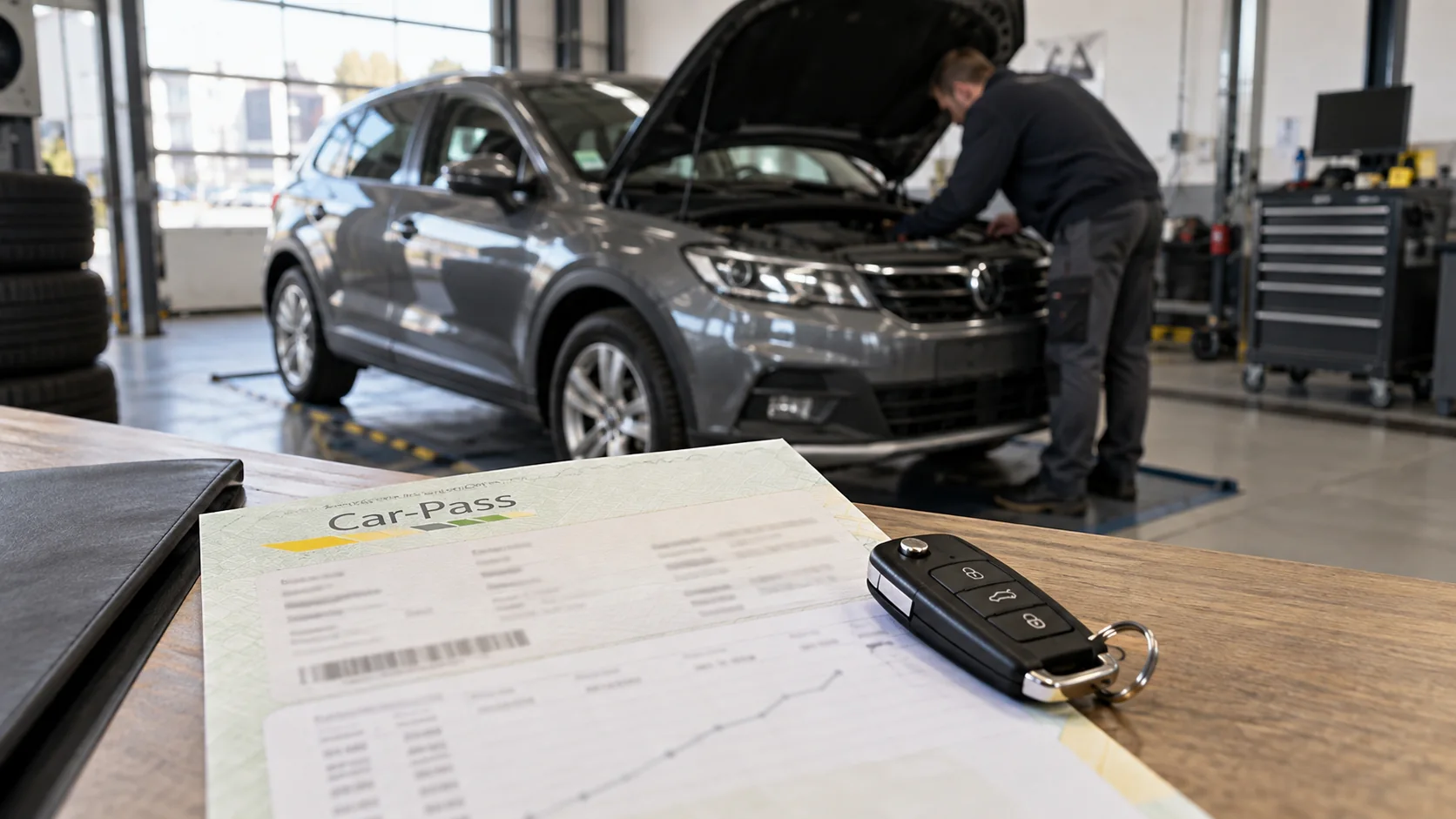
The Centralna Ewidencja Pojazdów (CEP), Poland’s vehicle register, contains information such as roadworthiness tests, deregistration and theft status, technical details and the validity of compulsory motor third-party liability insurance (OC). Test mileage readings have been collected since 2014; keeper numbers cover only the period since registration in Poland. Available foreign risk data may add information about the car’s earlier history. The PDF provides information; it is not an official document. 1
To access foreign data for a car outside CEP, you need a profil zaufany, a Polish verified electronic identity profile. If you have no access, ask the seller for a complete, current report. Ask which countries the car was previously registered in and compare its mileage history, servicing invoices and current odometer reading. Falling readings need a documented explanation; rising readings or missing entries prove neither an accident-free record nor a complete history, ownership or the actual total mileage. 1
When comparing nearby offers, the German-language guide to buying a car in Czechia and the German-language guide to buying a car in Slovakia can help you assess the vehicle records available in each country.
Establish the seller’s authority, original documents and payment arrangements together
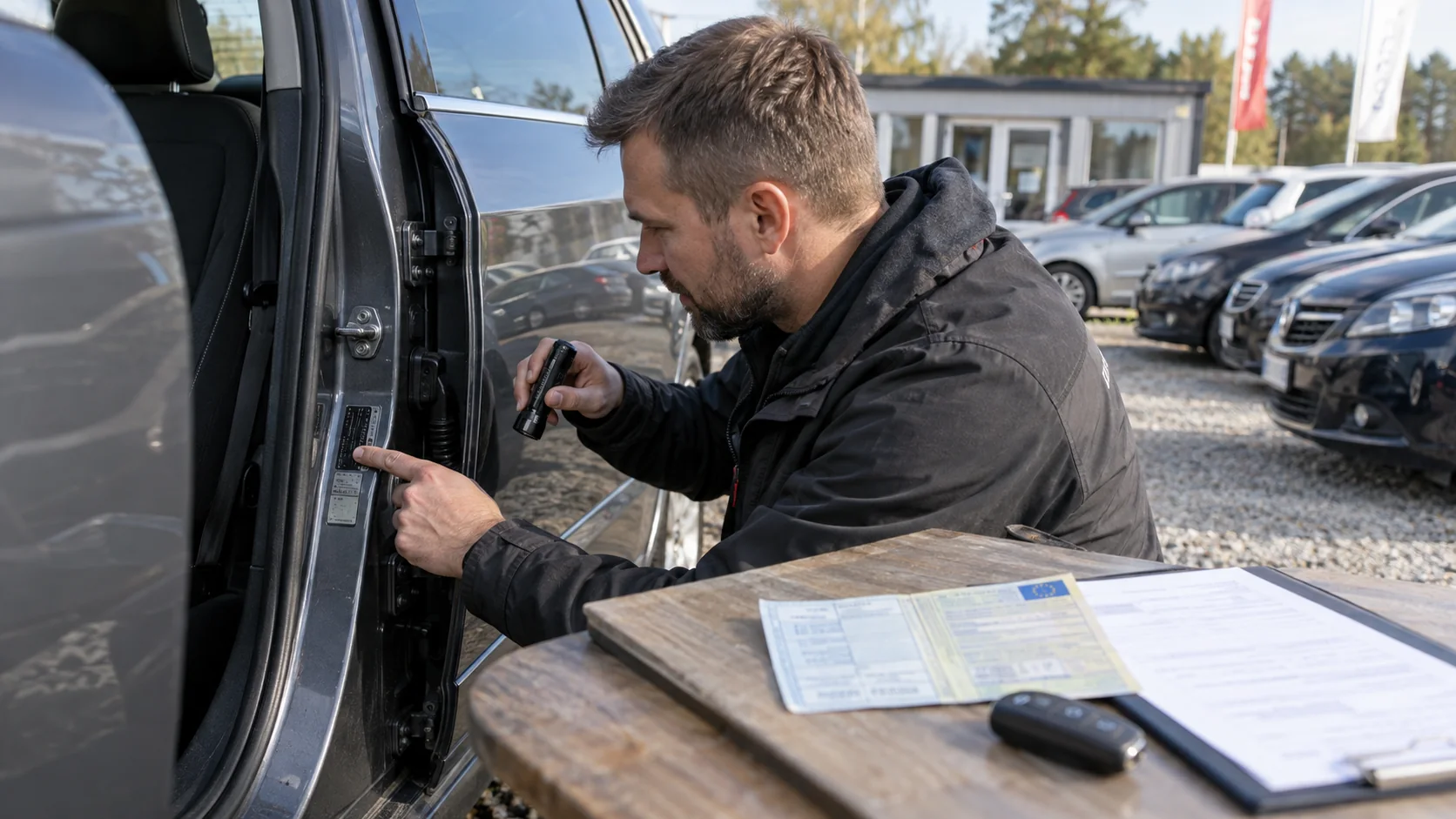
Match the VIN on the car against the original documents and contract. Check the owner, seller’s identity and authority to sell; for a company, also check authority to act on its behalf, for co-ownership the necessary consent, and for finance or leasing the release. Keys and a register report do not establish authority to sell. Record the parties, VIN, price and currency, mileage, known damage, original documents, keys, payment and handover arrangements in writing. If anything conflicts, postpone payment. Living in Germany does not automatically bring every German statutory warranty rule into play; establish the seller status and applicable law.
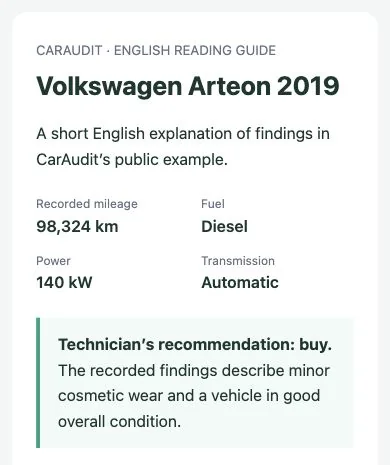
Public example: 2019 Volkswagen Arteon, 98,324 km, 140 kW, diesel, automatic.
Editorial English reading guide to the public example. Original: English navigation and Spanish technician notes; not the reader’s vehicle. An editorial reading guide, not a fully English version supplied by the provider.
| Evidence | What it helps you establish |
|---|---|
| Historia Pojazdu | Compare recorded events and mileage with supporting documents. |
| Original documents and authority to sell | Establish identity, ownership and lawful handover. |
| Pre-purchase inspection of the car | Current findings, photos and a recommendation to inform the purchase decision. |
Assess the current condition before deciding to buy
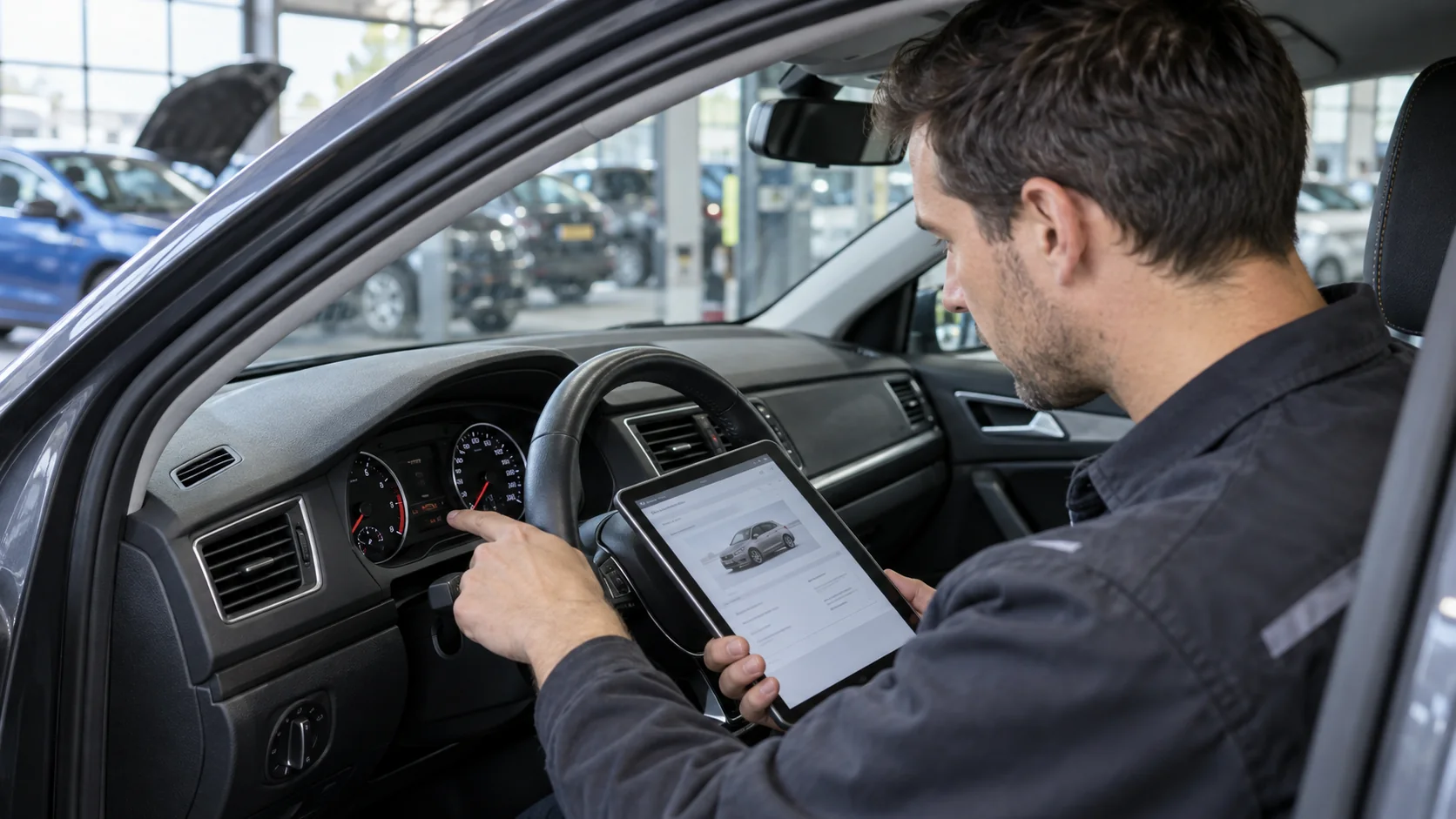
Have signs of repairs, paint measurements in the context of each panel, the underbody and corrosion, brakes, tyres, suspension, fluid leaks, engine and gearbox checked. A cold start, diagnostics and a test drive that is both legally permitted and technically safe add to the picture. A fault code is not a repair quotation; an empty fault memory does not establish mechanical soundness. A roadworthiness test addresses different questions from a pre-purchase inspection of condition and previous damage.
Arrange export registration and the handover of originals
The owner applies for temporary registration for export. If the owner has no permanent or temporary residence or registered office in Poland, the authority at the Polish place of purchase or collection is responsible. Before paying, agree who will become the owner, submit the application or act as an authorised representative. 5
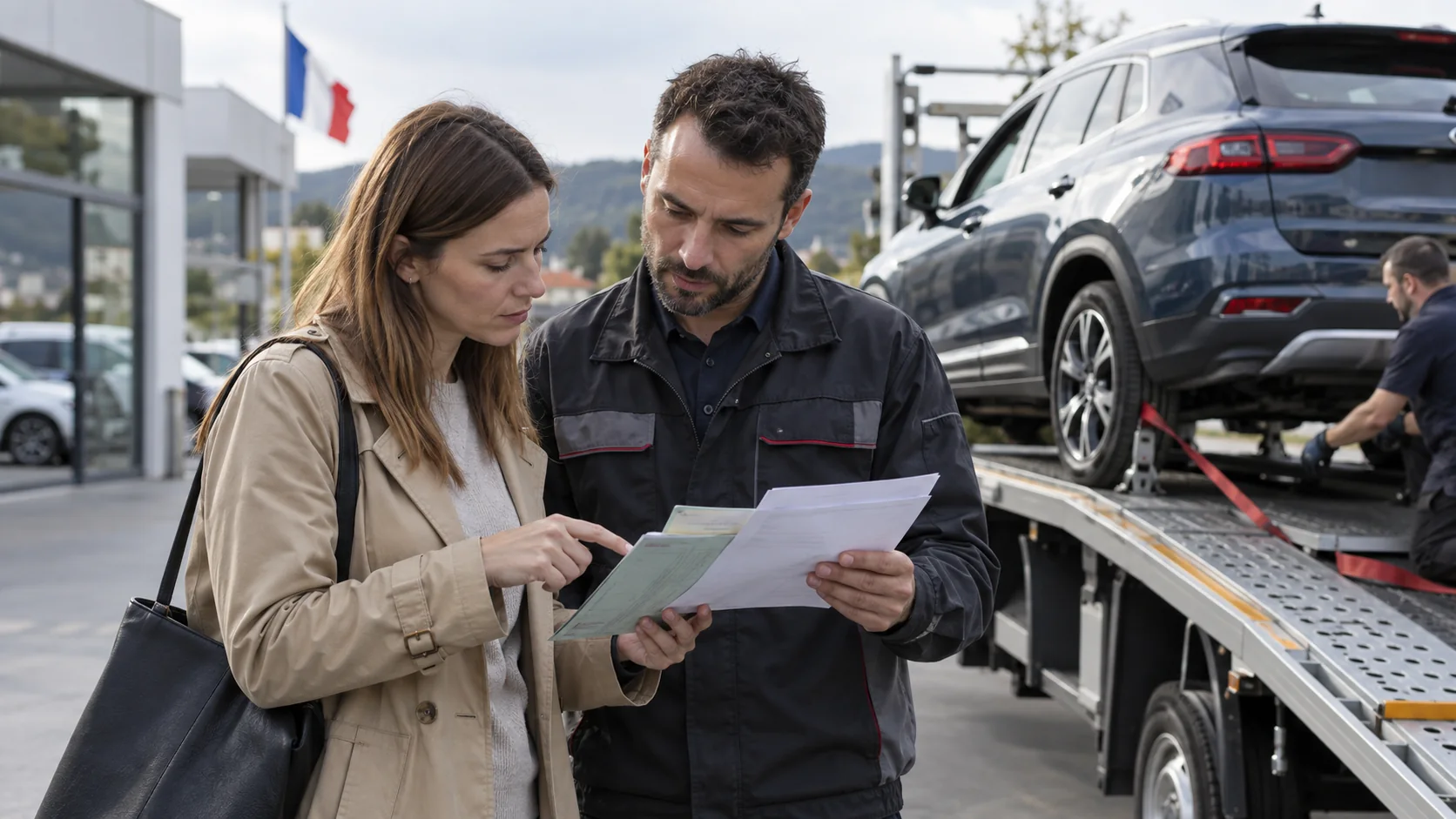
For a car already registered in Poland, prepare proof of identity, original ownership or purchase documents, the registration certificate, existing plates and, where required, proof of the roadworthiness test. Co-owners must attend or authorise a representative; a representative needs a power of attorney. Before handing documents over, establish which originals, cancelled documents or replacement documents you will receive for Germany. When a car is deregistered for registration in another EU state, the regulation provides for the cancelled registration certificate to be returned. 2 22 3
The authority issues a temporary decision, the pozwolenie czasowe temporary registration document and validated plates. Registration lasts no more than 30 days; a single extension of 14 days is available only to clarify registration matters. The approved expiry date is decisive. Anyone seeking deregistration by the authority through this export route submits an export declaration with the application, with penalties for a false declaration: the temporary permit and declaration together form this route under Article 79(3b). After actual export, the plates normally do not need to be returned. 5
Separately, deregistration by the authority under Article 79(3a) takes place when the Polish authority receives notification of registration from another EU state. German registration or sending a notification does not yet establish that the Polish process is complete: obtain confirmation of the status or decision. 5 23
Drive it home or have it carried?
Insure the car from the day of registration and obtain confirmation covering the vehicle, plates, period and entire Poland–Germany route. Check whether the seller’s policy actually provides cover after ownership changes. The German electronic insurance confirmation (eVB) for subsequent registration does not establish cover for the journey home. 2
| Option | Establish before collection |
|---|---|
| Driving it home | Valid registration and plates, roadworthiness and third-party liability cover for the exact route and dates. |
| Carried on a transporter or trailer | Agree a suitable transport quotation, collection date, payment and handover of original documents. |
For a longer collection journey, compare the full cost of driving and the transport quotation; the German-language guide to buying a car in Romania helps you compare a purchase option further away.
Establish these four stages before purchase and collection:
| Drive it home or have it carried? | Progress |
|---|---|
| Match the VIN, authority to sell and original documents before paying. | Open |
| Compare Historia Pojazdu, supporting documents and the current condition. | Open |
| Establish export documents, validity and insurance, or arrange transport with the car carried as a load. | Open |
| Check Polish purchase tax, German tax and inspection rules, and registration documents before buying. | Open |
Some evidence is still missing. Use the next steps listed.
Establish the tax position before signing the contract
Polish PCC: both filing and payment are required
On a taxable private purchase of a car located in Poland, the buyer is liable for Polish tax on civil-law transactions (PCC): 2% of market value, subject to exemptions. German residence alone does not provide an exemption. Transactions subject to VAT and those covered by the relevant statutory VAT exemption are excluded from PCC; check the seller status and invoice type. A tax base of up to and including PLN 1,000 qualifies for exemption: neither Form PCC-3 nor payment is required. 11 10
In an ordinary taxable case, you must file PCC-3 and pay the self-assessed tax within 14 days of the tax liability arising, normally when the contract is concluded, without waiting for a demand for payment. Do not wait for German registration. As a foreign buyer, establish the competent tax office beforehand; if jurisdiction cannot be determined under the main statutory rules, Article 12(2) names the Third Tax Office Warszawa-Śródmieście. 10
VAT: first use and mileage determine the position
For VAT purposes, a land vehicle is new if, at acquisition, it has travelled no more than 6,000 km or no more than six months have elapsed since first use. To be used, it must exceed both thresholds. A private buyer’s acquisition of a vehicle classed as new for tax purposes from another EU country is generally subject to 19% VAT in Germany. No VAT is charged on a private sale of a vehicle classed as used for tax purposes; dealers may sell under standard VAT rules or the margin scheme. The absence of a separately stated VAT amount does not establish the position on its own. There is no automatic entitlement to buy at a net price. No customs duty applies to this ordinary purchase within the EU. 12 13 20
German registration: agree the documents and inspection requirements in advance
The local registration authority determines the documents needed for the individual case. Usual requirements include original foreign documents and existing plates, the purchase contract or invoice, proof of identity, eVB and a SEPA direct debit mandate for vehicle tax; SEPA stands for Single Euro Payments Area. For type-approved cars, an EC Certificate of Conformity (CoC) or manufacturer data may be used. A missing CoC alone does not require an expert report under section 21 of the German Road Traffic Licensing Regulations (Straßenverkehrs-Zulassungs-Ordnung, StVZO); a lack of type approval, however, leads to the section 21 procedure. 14 23
If Part II is missing from a foreign document that is genuinely issued in two parts, confirmation from the competent foreign authority via Germany’s Federal Motor Transport Authority (Kraftfahrt-Bundesamt, KBA) is required. 15
The German periodic roadworthiness inspection (Hauptuntersuchung, HU) is governed by section 8 of the Vehicle Registration Ordinance (Fahrzeug-Zulassungsverordnung, FZV): for a vehicle with EU type approval previously used in the European Union or European Economic Area (EU/EEA), an inspection under section 29 StVZO is required before registration if it would be due under German intervals. A documented, qualifying inspection under Directive 2014/45/EU from the EU/EEA state where the vehicle was used can replace it; the next due date follows German law. If proof of first use is missing, the section 29 inspection is mandatory. Previous use outside the EU/EEA follows a separate route that also requires a section 29 inspection. Ordinary private passenger cars have their first HU after 36 months, then every 24 months; special uses have different intervals. 15 21
Calculate costs separately by purpose and currency
Germany’s schedule of fees for road traffic measures (Gebührenordnung für Maßnahmen im Straßenverkehr, GebOSt) sets individual German fees, not an overall import price. Polish export plates, the permit and stickers together cost PLN 111 in administrative fees; do not add this subtotal to the components again. Insurance is not included. 6 7
| Item | Amount | Condition / how to establish it |
|---|---|---|
| Purchase price | To be established | Establish the contract or invoice, seller status and actual currency. |
| German registration: base fee | €30.00 | GebOSt 221.1; additional services charged separately. |
| Data surcharge | €15.30 | Only if KBA data cannot be retrieved AND the data are unavailable in the local register. |
| Chosen registration number | €10.20 | Only if choosing a number outside the regular allocation. |
| Exchange of Fahrzeugbrief registration document | €5.10 | Only when exchanging a Fahrzeugbrief for registration certificate Part II. |
| Interchangeable registration plates | €6.00 | Only when these are allocated. |
| Temporary registration document | PLN 18.50 | For export; a component of PLN 111. |
| Passenger car export plates | PLN 80.00 | Export tariff; a component of PLN 111. |
| Plate validation stickers | PLN 12.50 | A component of PLN 111. |
| Power of attorney, where a fee applies | PLN 17.00 | Spouses, ancestors, descendants and siblings are exempt. |
| Certification of a copy | PLN 5.00 | Warsaw example: per page or part-page, only when the authority certifies an ordinary copy; originals and already certified copies are excluded. |
| CarAudit in Poland | €219.00 | Includes VAT and technician travel; car must be available and seller consent obtained. |
| Battery diagnostics, optional | €179.00 | Additional service; eligible electric and plug-in hybrid vehicles. |
| Cebia Autotracer, optional | €23.90 | Additional service; scope depends on available data. |
| Polish PCC, where taxable | To be established | 2% of market value; check exclusions and exemptions, file PCC-3 AND pay within 14 days. |
| German VAT, only if new for tax purposes | To be established | 19% of the statutory tax base; at acquisition, no more than 6,000 km OR six months since first use. |
| HU, CoC or expert report, modifications | To be established | Ask the testing organisation or manufacturer based on the vehicle documents. |
| German plates and further documents | To be established | Quotations and local requirements, without counting known surcharges twice. |
| Vehicle tax, annual cost budgeted separately | To be established | Calculate from vehicle data, engine capacity, CO₂, powertrain and first registration. |
| Insurance for driving it home OR transport | To be established | Obtain a quotation for the specific route; keep alternatives separate. |
| Travel and identified repairs | To be established | Plan travel and obtain workshop quotations for documented findings. |
Sources: 6 7 2 8 9 10 11 12 13 14 15 16 5 4
Obtain specific quotations for amounts still to be established. Keep PLN and EUR separate; driving the car home and having it carried are alternatives. Budget separately for annual vehicle tax and ongoing insurance. Otherwise, tax, insurance, technical work and the vehicle price may be missing from your comparison of an apparent bargain.
Frequently asked questions
What details do I need for Historia Pojazdu, and what remains unchecked?
The registration number, vehicle identification number (VIN, FIN in German) and date of first registration. Historia Pojazdu is free; CEP is the Polish vehicle register and OC is compulsory third-party liability insurance. Mileage readings from tests have been recorded since 2014; keeper numbers cover only the period since registration in Poland. Foreign data depend on availability; accessing them for a car outside CEP requires a profil zaufany, a verified identity profile. The PDF is not an official certificate. 1
Does an empty report prove the car has never been in an accident?
No. An empty or incomplete report proves neither an accident-free history nor complete mileage or ownership. Compare invoices, original documents and the current condition. 1
Can an owner without Polish residence apply for export registration?
Yes. An owner without permanent or temporary residence or a registered office in Poland applies to the authority at the Polish place of purchase or collection. Establish the application, ownership and representation arrangements before paying. 5
Which originals and powers of attorney do I need, and which documents will I get back?
Prepare purchase or ownership documents, the Polish registration certificate, proof of identity, plates and, where required, proof of the roadworthiness test. Co-owners must attend or authorise a representative; representatives need a power of attorney. Agree the return of originals beforehand: when deregistering for registration in another EU state, the cancelled registration certificate is returned. 2 3
How long are temporary registration and plates valid?
No more than 30 days; the approved dates for registration, plates and insurance are decisive. The single 14-day extension is only for clarifying registration matters. 5
Can I drive home using the seller’s existing plates or an eVB?
Only with confirmed valid registration and plates, roadworthiness and third-party liability cover for the entire journey. Check the seller’s insurance cover after ownership changes. A German eVB, the electronic insurance confirmation for subsequent registration, does not replace these checks. Otherwise, have the car carried on a transporter or trailer. 2 5
When does the Polish authority deregister the car?
Distinguish two routes: a temporary export permit plus an export declaration subject to penalties for false statements under Article 79(3b), or receipt of notification of registration from another EU state under paragraph 3a. German registration alone does not prove the Polish process is complete; check the status or decision. 5 3
When is proof of a Polish inspection sufficient for the German periodic roadworthiness inspection?
Under section 8 of Germany’s Vehicle Registration Ordinance (Fahrzeug-Zulassungsverordnung, FZV): for a vehicle with EU type approval previously used in the European Union (EU) or European Economic Area (EEA), a periodic roadworthiness inspection (Hauptuntersuchung, HU) under section 29 of the Road Traffic Licensing Regulations (Straßenverkehrs-Zulassungs-Ordnung, StVZO) is necessary if due under German intervals. A documented, qualifying inspection under Directive 2014/45/EU from the EU/EEA state where the car was used can replace it; the next due date follows German law. Without proof of first use, a section 29 inspection is mandatory; previous use outside the EU/EEA separately also requires a section 29 inspection. Ordinary private passenger cars: first HU after 36 months, then every 24 months; special uses have different intervals. 15 21
Is an already registered car with exactly 6,000 km used for VAT purposes?
No. No more than 6,000 km OR no more than six months since first use at acquisition means new for VAT purposes; used requires both thresholds to be exceeded. A German private buyer’s acquisition of a new vehicle from another EU country is generally subject to 19% VAT. No VAT is charged on a used private sale; establish the invoice type when buying from a dealer. 12 13 20
When does Polish PCC apply, and when must I file and pay?
Polish tax on civil-law transactions (PCC) is 2% of market value for a taxable private purchase of a car in Poland. Check VAT cases and statutory exemptions; a tax base of up to and including PLN 1,000 requires neither a return nor payment. Otherwise, file PCC-3 AND pay the tax within 14 days of the tax liability arising, normally when the contract is concluded, without waiting for a demand. German residence does not provide an exemption; establish the competent tax office beforehand. 11 10
How much do export plates and CarAudit cost in Poland?
Passenger car export plates cost PLN 80, the temporary registration document PLN 18.50 and stickers PLN 12.50: a total of PLN 111 in administrative fees, excluding insurance. CarAudit for a car in Poland costs €219 including VAT and technician travel. Select Poland in the form; ensure the car is available and obtain the seller’s consent. 7 2 8
Make a sound decision before paying
If ownership, original documents or significant findings remain unresolved, postpone purchase and collection. Agree payment against the arranged handover of the car, keys and original documents.
Sources
- Gov.pl — Historia Pojazdu
- Warsaw — temporary registration documents and current fees
- ELI — registrar actions regulation, annex1 export/deregistration
- CarAudit Deutschland — Was wir prüfen
- Polish Infrastructure Ministry — registration and export
- GebOSt Anlage — Gebührennummer 221
- ELI — vehicle registration fee regulation,3,4,5
- CarAudit German form — Polen selected
- CarAudit Deutschland — Leistung, Preis, Optionen und Länder
- ELI — consolidated PCC Act2026/191
- Gov.pl — PCC3 sale tax guidance
- UStG § 1b — innergemeinschaftlicher Erwerb neuer Fahrzeuge
- UStG § 12 — Steuersätze
- Bundesportal — Zulassung eines gebrauchten Kraftfahrzeuges aus einem EU-
- FZV § 8 — Zulassung nach vorheriger Zulassung in einem anderen Staat
- Zoll — Übersicht zur Kraftfahrzeugsteuer
- Carvago global vehicle selection directory
- CarAudit Deutschland — FAQ
- CarAudit German order — manually choose Polen
- Your Europe — VAT when buying or selling a car abroad
- StVZO Anlage VIII
- Wloclawek county — temporary plates
- Berlin — EU/EEA used vehicle registration