Buying a car in the Netherlands: check RDW records, export papers, transport, inspection, VAT and costs for private buyers in Germany before paying.
Before paying for a car in the Netherlands, establish who the seller is and check the original documents, history and condition, export and transport home, and German registration. A plausible RDW mileage record is no more sufficient on its own than a valid APK. What matters is whether the evidence matches the specific vehicle and whether your planned journey is permitted.
This guide is for private buyers resident in Germany purchasing a passenger car registered in the Netherlands. For an initial overview of buying abroad, use our German-language guide for car buyers in Germany.
Match the seller and car before paying
Ask for the registration number, vehicle identification number (VIN), current mileage and photographs of the documents. Later, compare the VIN on the car with the originals. With a private seller, check their identity, home address, authority to sell and whether ownership can be transferred. RDW recommends traceable payment rather than paying in advance or in cash. If someone acts on the seller’s behalf, document their authorisation too. 12
Record the stated mileage, known defects, price, original documents to be supplied and handover arrangements in the contract. Once the documents are in order, inspect the actual car.
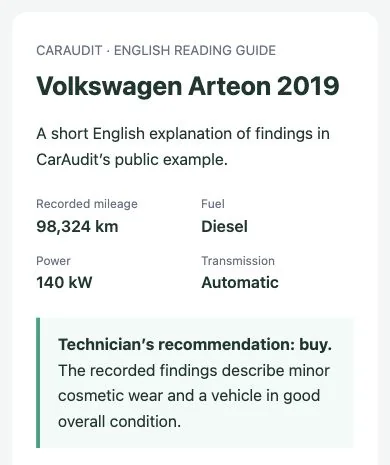
Open the English reading guide to the public CarAudit example
Editorial English reading guide to the public example. The original report has English navigation and Spanish technician notes. The example is not your vehicle.
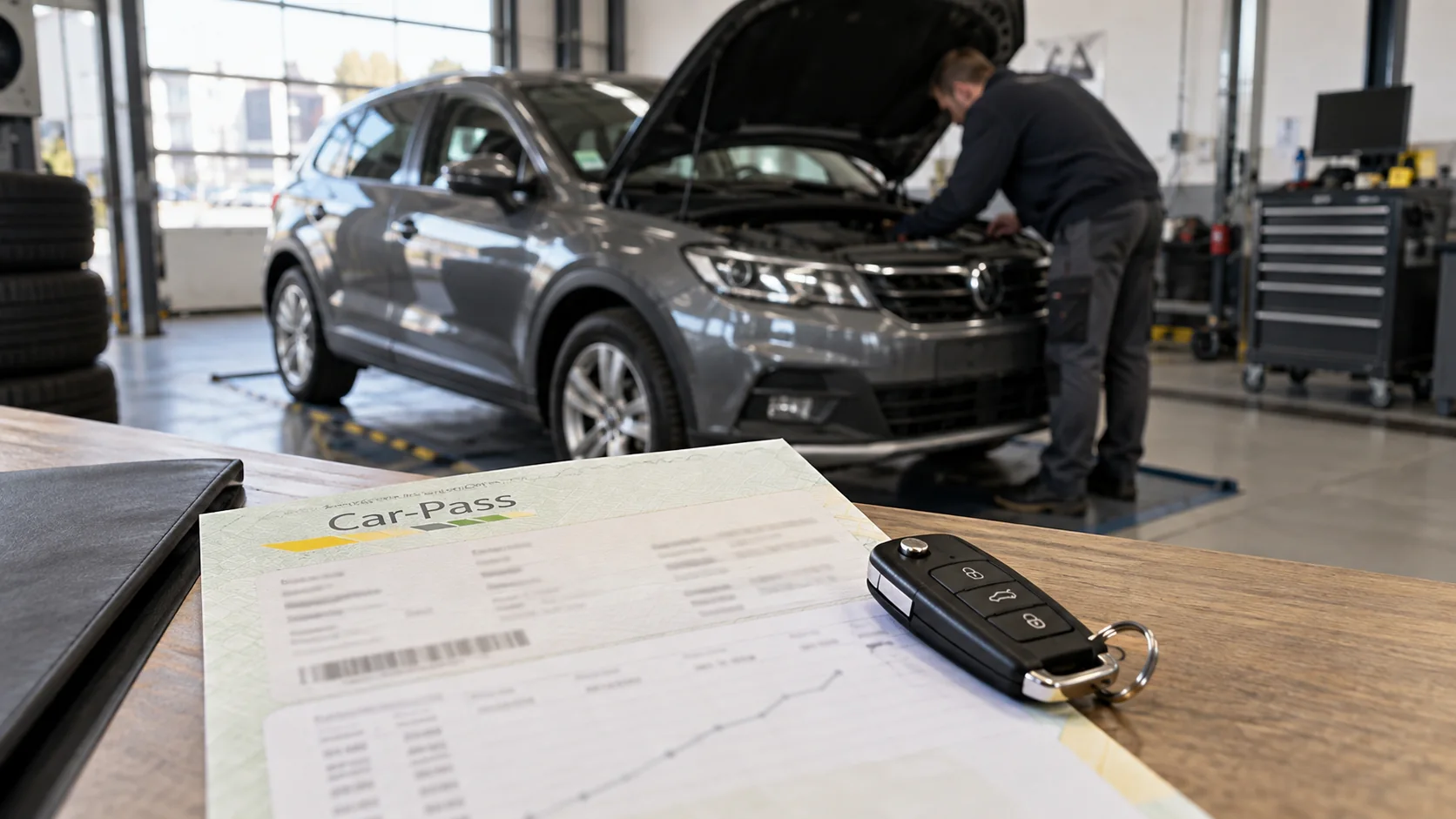
The reading guide features a Volkswagen Arteon from 2019: 98,324 km, diesel, 140 kW, automatic. The example combines a recommendation to buy with minor cosmetic wear, factory paint readings without visible signs of repairs, smooth engine running and gear changes, no visible oil leaks and light surface rust on the brakes. It shows how to read the recommendation alongside the individual findings. 18 19
Read RDW records, mileage and vehicle condition together
Check the registration number and current odometer reading with RDW. “Logisch” means the stored readings form an increasing sequence; “onlogisch” indicates a discrepancy, while “geen oordeel” means there is insufficient evidence for an assessment. A NAP mark does not confirm a complete vehicle history. Add invoices, service records and the RDW vehicle report, and compare first registration with the first Dutch registration. 12
Since 3 February 2026, RDW has included German mileage data for vehicles imported from Germany. It does not add these retrospectively for Dutch registrations completed before that date. Even an increasing imported history can retain “Geen oordeel vanwege invoer”: other countries of previous registration may be unknown. Ask for evidence covering those periods. 13
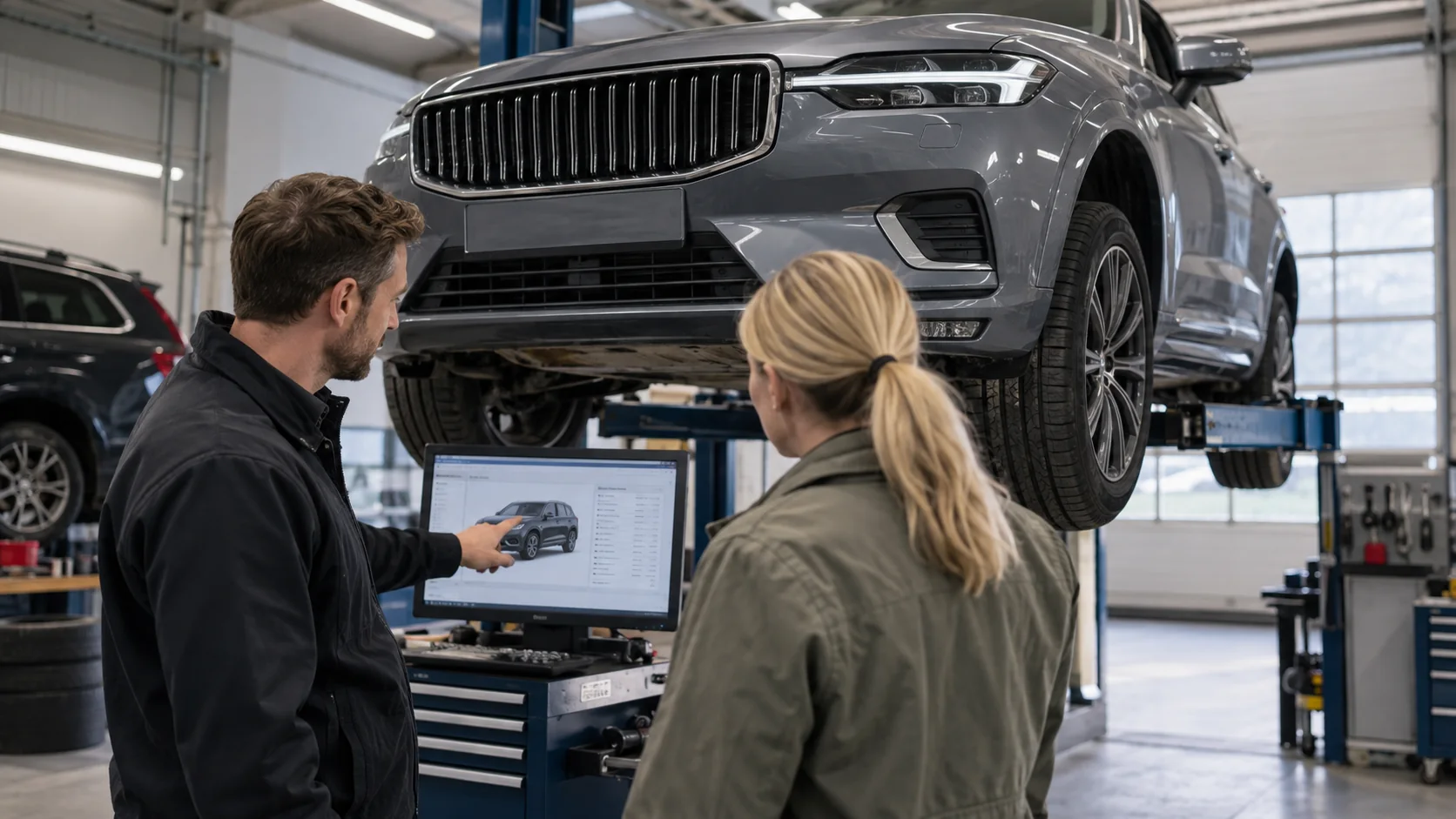
Compare the documented history with wear and findings on the car. The CarAudit inspection scope, explained in German includes the bodywork, underbody, brakes, suspension and drivetrain. Photographs and a coherent report help you understand any issues when deciding whether to buy. 14
If a Belgian car is also on your shortlist, the German-language guide to buying a car in Belgium helps you check the documents and collection arrangements for that option before choosing.
Clarify BPM in the export price in writing
BPM is a Dutch vehicle tax. For cars already used on Dutch roads, a refund requires:
| Clarify BPM in the export price in writing | Progress |
|---|---|
| BPM to have been paid and the first Dutch registration number to have been obtained on or after 16 October 2006; | Open |
| at the end of Dutch registration, the vehicle must neither be designated for scrapping, registered as awaiting inspection, nor a “schadevoertuig” under the Dutch definition of severe damage; | Open |
| RDW “Export” status, actual transfer and permanent registration in Germany within 13 weeks of RDW Export status. 16 17 | Open |
Not all evidence has been marked as reviewed yet. Use the next steps listed.
Separately, the signed application with a copy of the German registration evidence must be sent within 13 weeks after Dutch registration ends. Evidence of transport must be retained. 17
Amounts below 50 euros are not refunded. The authority pays the last Dutch registration holder. Agree in writing who will supply the application and evidence on time, and whether the economic benefit is already included in the export price. This does not change the authority’s legal payee. A refund is not an automatic discount: do not deduct the same benefit twice. 17
Cars that have not been used on Dutch roads follow a separate part of the form with different conditions. Check the applicable case in the current Belastingdienst form. 17
Arrange export papers and transport home before collection
Use the regular export procedure at RDW or a recognised export company. RDW recommends that foreign buyers export in their own name so their details appear on Part II. You need identification, the registration card with its registration code, or the older Part 1B documents with proof of transfer, and the number plates. The seller must have missing registration documents replaced before export. 1
You receive the Vrijwaringsbewijs, which releases the previous registered holder from responsibility, the invalidated registration document and the export certificate Part II. The latter and the registration document belong together for registration abroad. If a car already abroad is subsequently deregistered online, RDW issues no Part II. Clarify the documents before deregistration and departure. 1
After export deregistration, RDW specifies 14 days on Dutch public roads with export plates: the existing registration number in black characters on a white background. A passenger car needs insurance and a valid APK, the Dutch roadworthiness inspection. If either condition ceases to be met sooner, the 14-day period does not extend permission to drive. Permission and insurance cover must be confirmed separately for Germany and any transit countries. 1
| Option | Evidence needed | Main risk | Cost status |
|---|---|---|---|
| Self-drive | Export papers, insurance, valid APK; permission for every leg of the journey | RDW’s 14 days apply only on Dutch roads | To be determined: obtain quotes for plates and insurance; calculate your own travel costs |
| Carried on a trailer or vehicle transporter | Export and vehicle papers; transport order and insurance cover | Agree the scope of service and handover clearly | To be determined: ask the carrier for a quote for the route and vehicle |
Sources: 1
Agree German registration and inspection requirements early
If possible, send your registration authority copies of the available documents before buying. You will usually need the original registration documents, existing number plates, purchase contract or invoice, proof of identity, EC certificate of conformity (CoC) or an expert report, electronic insurance confirmation (eVB), SEPA details for motor vehicle tax and the required inspection evidence. Clarify any additional requirements with the local authority. 10
For a foreign registration certificate in two parts, section 8 FZV permits German registration without Part II only after confirmation by the competent foreign authority via the Kraftfahrt-Bundesamt. Clarify any missing original before paying. A Dutch individual approval document (IGC) without registration evidence is also a special case; have its eligibility for registration checked. 9 1
For an EU-type-approved vehicle previously used in another EU/EEA state, an inspection under section 29 StVZO is required before registration if one would already be due under German intervals. A documented inspection under Directive 2014/45/EU from the EU/EEA state of previous use can replace this inspection. The next due date then also follows German intervals. A young vehicle may not yet be due an inspection. If evidence of first use is missing, a German section 29 inspection is required. If the EU-type-approved vehicle was previously used outside the EU or EEA, an inspection under section 29 StVZO is required before registration. Have your APK documents assessed against your specific case. 9 10
VAT: an advert saying “used” does not decide the tax treatment
A vehicle is new for tax purposes if it has travelled no more than 6,000 km OR no more than six months have passed since first use at the time of acquisition. It is used for tax purposes only with more than 6,000 km AND more than six months. Exactly 6,000 km therefore still meets the new-vehicle test. When a private buyer in Germany makes a permanent intra-Community acquisition of a car that is new for tax purposes, German VAT applies at the general rate of 19% on the statutory taxable amount. Clarify declaration, payment and invoice treatment with the tax office beforehand. 6 7 8
For a car that is used for tax purposes, a private seller does not charge VAT on the sale. A dealer may apply ordinary VAT or the margin scheme. The absence of separately stated VAT does not, on its own, establish a particular tax treatment. Cross-border transport alone does not trigger German acquisition VAT. Ask for the procedure applied to be explained on the invoice. 8 20
Calculate costs for the specific vehicle
The table separates fixed amounts, conditional surcharges and figures you still need to obtain. The 30 euros under GebOSt 221.1 are the base fee, rather than the total registration cost. Each of the four administrative surcharges listed applies only in its particular case. Choose either self-drive or vehicle transport, and only the additional services you want. 2
| Item | Amount | When it applies | Check before paying |
|---|---|---|---|
| Purchase price | To be determined | Contract and tax treatment | Have the invoice and price confirmed in writing |
| German registration base fee | EUR 30.00 | GebOSt 221.1 | Other applicable costs are separate |
| Export directly through RDW | EUR 12.00 | RDW procedure | Export companies set their own fees |
| CarAudit inspection | EUR 319.00 | Includes VAT and technician travel | Agree the location, access and availability |
| Optional battery diagnostics | EUR 179.00 | In addition to the base inspection | Confirm the electric car or plug-in hybrid is eligible |
| Optional Cebia history report | EUR 23.90 | As listed in the German offer | Data depth depends on the vehicle’s history |
| Transport, insurance and plates | To be determined | Self-drive or carrier | Obtain quotations for the chosen route |
| German VAT | To be determined | Only if new for tax purposes; rate 19% | Clarify the taxable amount with the tax office |
| Roadworthiness inspection, CoC/expert report, technical work | To be determined | Depends on the vehicle and evidence | Establish the authority’s requirements and obtain an inspection quote |
| Other documents and number plates | To be determined | Only items actually required | Obtain authority and plate quotations without double counting |
| Surcharge for unavailable data retrieval | EUR 15.30 | Only if retrieval from KBA is not possible and the data are also absent from the local vehicle register | Confirm applicability with the registration authority |
| Personalised registration number surcharge | EUR 10.20 | Only if you choose a personalised registration number | Confirm your choice and the applicable fee |
| Exchange of a Fahrzeugbrief | EUR 5.10 | Only when exchanging it for a registration certificate Part II | Clarify applicability with the registration authority |
| Interchangeable number plate surcharge | EUR 6.00 | Only for interchangeable plates | Confirm the chosen type of registration |
| Annual motor vehicle tax, separate | To be determined | Running cost; vehicle-specific | Calculate using engine capacity, CO₂ and first registration |
Sources: 2 1 3 4 5 6 7 8 9 10 11
Annual motor vehicle tax is a running cost. It depends on factors including engine capacity, CO₂ and the first-registration category, and remains separate from the one-off purchase budget. Enter the vehicle-specific amount once the details are known. Without the outstanding quotations, a total price would be incomplete. 11
When can you proceed, and when should you ask first?
| Finding | Decision | Why |
|---|---|---|
| VIN or authority to sell unclear | Pause payment and clarify | The vehicle’s identity must match the seller’s dossier |
| Mileage discrepancy or gap in import history | Ask for evidence and inspect the condition | A register assessment does not explain a complete history |
| Part II or inspection evidence missing | Contact the registration authority before buying | Confirmation or specific inspection requirements must be established |
| Documents, tax treatment and condition clarified | Agree the contract and suitable collection arrangements | Base the decision on evidence and current findings |
If comparing an Austrian offer, use the German-language guide to buying a car in Austria to check its documentation and collection requirements. For a vehicle in Luxembourg, the German-language guide to buying a car in Luxembourg helps you include the work needed before driving home in your comparison. Base your decision on the complete dossier and your specific quotations.
Four steps before collection
Complete these four stages before making a binding commitment:
- Compare the VIN, seller’s identity, authority to dispose of the car and all original documents before paying.
- Cross-check RDW data, mileage history, invoices, the advert and the car’s actual condition.
- Choose self-drive or transport before signing the contract, and obtain written confirmation of insurance and permission for every leg of the journey.
- Clarify the CoC or expert report, roadworthiness inspection evidence, eVB, tax details and complete German registration dossier before collection.
Frequently asked questions
Can I drive to Germany on Dutch export plates for 14 days?
RDW’s statement covers 14 days on Dutch public roads. A passenger car needs insurance and a valid APK. Permission and insurance cover must be clarified separately for the German part of the journey; otherwise, transport with the vehicle carried as a load is an option. 1
Which RDW documents do I need for German registration?
The regular export package includes the Vrijwaringsbewijs, the invalidated Dutch registration document and export certificate Part II. The latter two documents are needed together for registration abroad. Subsequent online deregistration from abroad does not provide Part II. 1
What does “Geen oordeel vanwege invoer” mean for the mileage?
Previous imports prevent RDW from giving a conclusive mileage assessment. German import data included since 3 February 2026 are not added retrospectively for older Dutch registrations. Even increasing readings can retain this status. Obtain evidence for earlier periods of use. 13
What happens if Dutch Part II is missing?
For a foreign registration certificate in two parts, section 8 FZV allows registration without Part II only after confirmation by the competent foreign authority via the Kraftfahrt-Bundesamt. Clarify this procedure with your registration authority before payment and collection. 9
When is a car still new for VAT purposes?
When it has travelled no more than 6,000 km OR no more than six months have passed since first use at the time of acquisition. Used status requires both figures to be above those limits. For a permanent intra-Community acquisition of a car that is new for tax purposes by a private buyer in Germany, German VAT applies at 19% on the statutory taxable amount. 6 7
Does a possible BPM refund automatically reduce my price?
No. The authority pays the last Dutch registration holder; amounts below 50 euros are not refunded. Agree the price benefit and timely administration in writing. Observe both 13-week obligations and the applicable use category in the BPM section. 16 17
Is a valid Dutch APK sufficient as a German roadworthiness inspection?
It depends on the case. For an EU-type-approved vehicle previously used in another EU/EEA state, a section 29 inspection is required before registration if it would be due under German intervals. A documented inspection under Directive 2014/45/EU from the EU/EEA state of use can replace it; the next due date follows German intervals. If evidence of first use is missing, a German section 29 inspection is required. If the EU-type-approved vehicle was previously used outside the EU or EEA, an inspection under section 29 StVZO is required before registration. Submit the APK evidence to your registration authority. 9 10
What does CarAudit charge to inspect a car in the Netherlands?
The standard inspection costs 319 euros including VAT and technician travel. Optional extras, as listed in the German offer, are 179 euros for battery diagnostics on an eligible electric car or plug-in hybrid, and 23.90 euros for the Cebia history report. Agree access and vehicle availability with the seller. 3 4 5
Have the selected car inspected before buying
Sources
- RDW — Exporting a vehicle
- GebOSt Anlage — Gebührennummer 221.1
- CarAudit Deutschland — Leistung, Preise, Länder und Bestellung
- CarAudit Deutschland — Bestellabschnitt
- CarAudit Deutschland — Bestellung, Fahrzeugstandort Niederlande
- UStG § 1b — innergemeinschaftlicher Erwerb neuer Fahrzeuge
- UStG § 12 — Steuersätze
- European Commission — Buying and selling cars: VAT
- FZV § 8 — Zulassung nach vorheriger Zulassung in einem anderen Staat
- Bundesportal — Zulassung eines gebrauchten Kraftfahrzeuges aus einem EU-Land
- Zoll — Übersicht zur Kraftfahrzeugsteuer
- RDW — Tips for buying a vehicle
- RDW — German odometer readings in the register
- CarAudit Deutschland — Was wir prüfen
- Carvago — Fahrzeugangebot und Länderprüfung
- Belastingdienst — BPM refund when exporting a used vehicle
- Belastingdienst — Antrag BPM-Erstattung, aktuelles Formular BPM0451Z27
- Approved CarAudit English editorial reading guide
- Original public CarAudit report linked from the approved guide
- UStG § 25a — Differenzbesteuerung