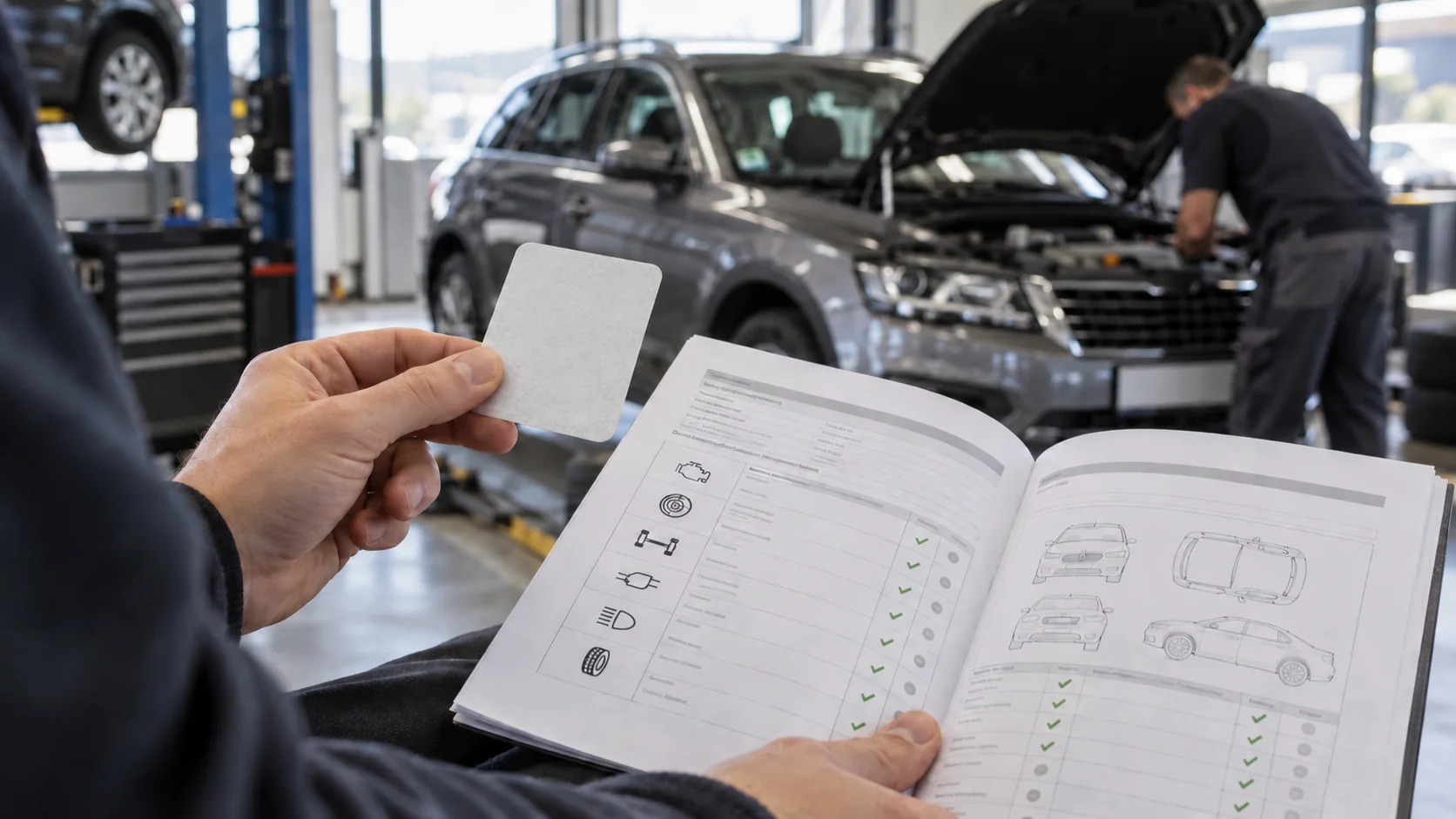
Check HistoVec, the Carte grise and inspection documents, and arrange valid transport before buying a French used car for Germany.
Before paying a deposit, request the HistoVec link, a current administrative status certificate and photographs of the Carte grise. Check the seller, vehicle identification number (VIN) and documents against one another, then have the present condition inspected. Agree on the price and handover only once transport to Germany and the documents required there are also settled.
This process covers a used passenger car already registered in France, from the European part of France, which you buy as a private individual resident in Germany and intend to register there. An important restriction concerns the return journey: the detachable coupon of the Carte grise is not sufficient for driving to Germany, as Service Public explicitly states.
Contents: HistoVec · Purchase documents · Contrôle technique · Journey home · Condition inspection · Checklist · Germany and costs · FAQ
How do you obtain HistoVec and the administrative status certificate?
Ask the seller to generate the free HistoVec report and send you its official link. The owner uses information from their registration certificate to do this. The report provides access to registered events, such as changes of keeper and certain damage subject to a supervised repair procedure. It is not a complete accident file. Compare the information with maintenance invoices and available CT inspection reports. If the car was previously registered in another country, request evidence for that period too: being advertised in France does not close a gap in its history. The government HistoVec project page explains access.
Distinguish this from the mandatory certificat de situation administrative (CSA). The seller must give you this administrative status certificate before the sale; it must be less than 15 days old. HistoVec can also provide it. The document's contents and issue date matter, not merely the existence of a link. Service Public explains the CSA requirements.
A gage is a lien, often related to financing. By itself, it does not prevent a sale. An opposition, however, blocks the change of owner and must be lifted before the sale. Obtain specific evidence concerning financing and release instead of transferring money on the strength of a verbal promise. The French administration explicitly distinguishes the two cases.
Which documents are handed over when buying?
In a private sale, check that the seller's identity matches the Carte grise and that the person has authority to sell. If several people are named, all their signatures are required. A lessee cannot simply sell the leasing company's vehicle. The VIN on the car must match the documents. Service Public describes the conditions for sale.
Take the complete original Carte grise. The seller crosses it out and writes “vendu le”, with the sale date, time and signature. They also complete and sign the designated coupon without detaching it. You additionally receive your copy of the certificat de cession, Cerfa 15776, signed by both parties, the current CSA and, where required, the CT report. These documents are not interchangeable: a copy of the purchase contract does not replace the Carte grise. The official handover list identifies each document.
Also record the price, VIN, mileage, known damage, supplied documents, keys and handover time in writing. When buying from a dealer, establish which company is your contractual partner. Living in Germany does not automatically transfer all German warranty rules to the French contract; ADAC also highlights the applicable contract law.
The seller must report the sale to ANTS within 15 days of signing the Certificat de cession. Agree that they will forward the acknowledgement of receipt and the generated Code de cession to you. This code serves the French procedure; it is not German registration. Simplimmat is not an appropriate standard solution here, because both seller and buyer must live in France to use it. The ANTS steps and residence restriction are set out in the French sale guide.
How recent must the Contrôle technique be?
When selling a passenger car over four years old to a private individual, the seller must hand over the CT report. Read not only the date but also the result and every listed defect. Service Public requires a CT less than six months old and explicitly relates that period to submission of an application for a new French registration certificate. This is not automatically the deadline for your German registration. Source: French sale guide.
If a contre-visite, or reinspection, is required, the two-month period from the initial inspection must not have expired. A sale with reinspection still outstanding may be possible within this period. For critical defects, however, repairs and reinspection must take place before a sale to a private individual. Agree not only who will repair the car but also which reports will be available at handover. Service Public distinguishes these cases.
Send the existing CT report to your German registration authority before buying and ask whether it is sufficient inspection evidence or an HU inspection is required. A CT that is not yet due in France does not automatically mean Germany requires no evidence: Berlin generally specifies the first HU for passenger cars after three years. German registration requirements must be checked separately.
Is the detachable coupon sufficient for driving to Germany?
No. The coupon is intended for temporary use within France, not for crossing the border. The complete but already crossed-out Carte grise is no substitute either: Service Public rules out driving abroad with it.
The clear alternative is to carry the car as a load on a suitable trailer or transporter. To drive it home, registration, plates, roadworthiness and insurance for the entire route must be settled in advance. Do not assume the seller's existing plates and insurance remain sufficient after the sale. ADAC explains the transport options.
An ordinary CPI is valid only in France. A CPI WW may be available for certain export cases; its validity abroad depends on recognition in the country concerned. Ask ANTS or an authorised registration service to confirm suitability for this particular vehicle, and the responsible authorities to confirm recognition in Germany and any transit countries. The insurer must cover the actual journey. Without a confirmed solution, arrange transport instead of relying on a blanket promise about WW plates. Source: Service Public on CPI and CPI WW.
What should be inspected before you pay?
Bodywork, underbody and powertrain
Have documented damage and CT defects specifically rechecked on the car. This includes repair traces on the body and structural areas, corrosion, underbody, brakes, tyres, suspension, engine and gearbox or electric drive. Arrange lift access in advance. Photographs and a findings report should show what was actually examined. A single paint measurement without context proves neither a serious accident nor an accident-free history. The difference between an HU and a pre-purchase check lies precisely in the additional assessment of condition, previous damage and wear.
Test drive, diagnostics and remaining limitations
Before the appointment, establish whether a legally and technically permissible test drive and diagnostics are possible. Have cold-start behaviour, gear changes, braking, steering and unusual noises checked, for example. A fault code is not yet a repair price; an empty fault memory does not confirm the absence of defects. The report must explicitly identify areas that were inaccessible or not tested, as required by the limitations of our inspection scope.
A pre-purchase inspection is a recommendation for your buying decision, not a general legal prerequisite for purchase. Pause payment or departure while identity, a transfer restriction, essential original documents or a serious technical finding remain unresolved. Replacing missing evidence with a lower price does not resolve the outstanding issue.
Your checklist before purchase and collection
Use these six questions when speaking with the seller. “Open”, “Evidence reviewed” and “Discrepancy to resolve” reflect only your own assessment. Even six reviewed pieces of evidence do not automatically clear the car for purchase.
| Check question | What the evidence means | Next step | Source / checked | Progress |
|---|---|---|---|---|
| How do you obtain HistoVec and the administrative status certificate? | The administrative certificate must be less than 15 days old; references to a gage or opposition must be resolved individually. | Request the HistoVec link and a current administrative certificate from the seller; resolve each entry. | Service Public: sell or give away a vehicle; Service Public: administrative status, gage and opposition; 2026-09-07 | Open |
| Which documents are handed over when buying? | The complete Carte grise and signed sale document must be handed over. | Collect the complete Carte grise and signed transfer document; agree on the seller's notification. | Service Public: sell or give away a vehicle; 2026-09-07 | Open |
| How recent must the Contrôle technique be? | Specific CT evidence and deadlines apply to a passenger car over four years old; German recognition must be established separately. | Read the inspection date, result and reinspection deadline; establish German registration evidence before buying. | Service Public: sell or give away a vehicle; Service Berlin: register an EU/EEA used vehicle; 2026-09-07 | Open |
| Is the detachable coupon sufficient for driving to Germany? | The detachable coupon does not permit driving abroad. | Book return transport before collection or arrange registration and insurance confirmed for the entire route. | Service Public: sell or give away a vehicle; ADAC: buying a used car abroad in the EU; 2026-09-07 | Open |
| Has the current technical condition been investigated adequately? | Register information does not replace a vehicle inspection. Inaccessible parts remain unchecked. | Request an inspection report covering bodywork, underbody, powertrain and test drive; document limitations. | TÜV NORD: AutoKaufCheck; CarAudit: what we inspect; 2026-09-07 | Open |
| Are the German registration documents agreed? | Confirm original papers, proof of purchase, eVB, technical data and required inspection evidence with your registration authority. | Before buying, establish the vehicle-specific document requirements with the responsible registration authority. | Service Berlin: register an EU/EEA used vehicle; 2026-09-07 | Open |
Some evidence is still missing. Use the next steps listed.
How do you prepare for costs and registration in Germany?
Which taxes apply when buying a used car in the EU?
For VAT purposes, the car is used only if it has travelled more than 6,000 km and is supplied more than six months after first registration. Exactly 6,000 km or no more than six months each results in classification as a new vehicle for tax purposes. The EU rules for private car buyers are decisive, not the description in the advert.
For the ordinary EU used-car purchase covered here, moving the car to Germany incurs neither customs duty nor additional German VAT. A private sale is not subject to VAT; a dealer's invoice follows the VAT regime applied, possibly margin taxation. This does not imply an automatic net-price purchase. A car that is new for tax purposes is instead taxed in Germany as the destination country. Before buying, clarify this case, including declaration and payment, with your tax office rather than postponing the tax question until after registration. Source: Your Europe.
What does the German registration authority need?
As a specific local example, Berlin lists original foreign vehicle documents, a purchase contract or invoice, proof of identity, eVB electronic insurance confirmation, a SEPA mandate and technical data. For type-approved vehicles, a COC or manufacturer data confirmation serves this purpose. The required inspection evidence and any existing foreign plates are also needed.
For vehicles without type approval, Berlin requires an expert report under section 21 StVZO. However, a missing COC alone does not automatically mean this exact procedure is necessary. Before buying, have your responsible registration authority confirm which documents are sufficient for the specific car. Berlin also notes that its notification to the country of origin does not ensure automatic deregistration there. The seller's French sale notification therefore remains a separate step. Source: Service Berlin.
How do you budget for transport and the total cost?
Add together the price, pre-purchase inspection, transport or transit registration and insurance, document procurement, any HU inspection or expert report, German registration and documented repairs. Obtain quotations before comparing the total with a car in Germany. A missing transport quotation remains an unresolved cost, not zero euros. The ADAC guidance on purchase and transfer helps you prepare.
FAQ
Can I drive to Germany with the detachable coupon?
No. It does not permit driving outside France. Arrange transport or registration and insurance confirmed for the whole route. Service Public.
How old may the French administrative status certificate be?
It must be less than 15 days old when handed over before the sale. Check the CSA issue date. Service Public.
Can I use Simplimmat as a buyer resident in Germany?
Not for this purchase: the procedure requires both parties to live in France. The seller instead uses the appropriate ANTS notification procedure. Service Public.
Have the selected car inspected on site
With CarAudit, we also inspect vehicles in France. Confirm availability for the specific location before ordering. The possible inspection scope depends on access to the vehicle and test-drive conditions; parts are not dismantled. The report is not a guarantee within the meaning of the law.
View inspection scope and availability · What is inspected on the vehicle?