Buying a car in Austria: check original papers, Pickerl, transfer plates, NoVA, German VAT, HU, registration and costs.
Before irreversible payment, German private buyers should separate four decisions: vehicle identity and authority to sell; whether condition justifies the price; safe export arrangements for the route; and complete German tax and registration papers. A Pickerl, attractive advert or single register result cannot answer these questions. A reliable total requires the vehicle, seller type, VAT treatment, transport and local inspection and registration costs.
This guide covers a used passenger car previously registered in Austria, bought by a private resident of Germany. The German-language guides to buying a car abroad cover other source countries; their rules are not interchangeable.
Before paying: verify identity, seller and originals
Match the vehicle identification number (VIN) on the car against both Austrian registration-certificate parts, the contract or invoice, approval and inspection papers. Check seller ID; if names differ, clarify authorisation, ownership or disposal rights and any finance. The contract should itemise price, mileage, known damage, promised qualities, included accessories and every original handed over.
Austrian transfer-plate applications require, among other things, identity, ownership or purchase evidence, approval or type documentation, any relevant foreign vehicle document and a current report if inspection is due. A representative needs written authorisation. 1
German registration of a used car previously registered in the European Union (EU) or European Economic Area (EEA) typically requires foreign vehicle papers and existing plates, contract or invoice, an EU Certificate of Conformity (CoC) or required expert report, electronic insurance confirmation (eVB), SEPA details for German vehicle tax and appropriate periodic roadworthiness inspection (HU) evidence. The registration authority may request further documents. 2 3
Missing Part II of a two-part foreign certificate is no routine paperwork issue: under § 8 of Germany's Vehicle Registration Regulation (FZV), registration requires confirmation from the foreign authority through the Kraftfahrt-Bundesamt. Clarify this with your registration office before paying. 3
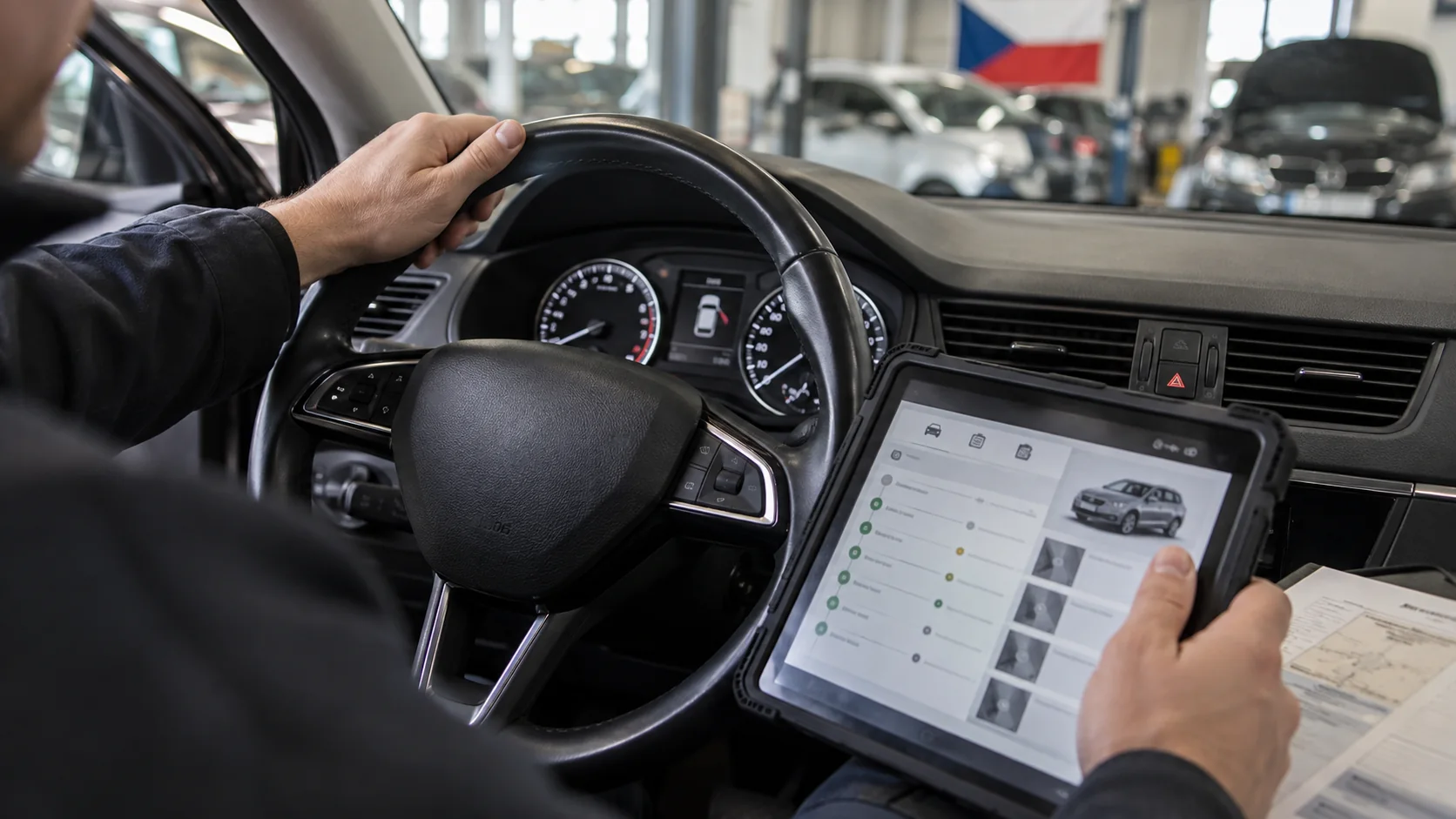
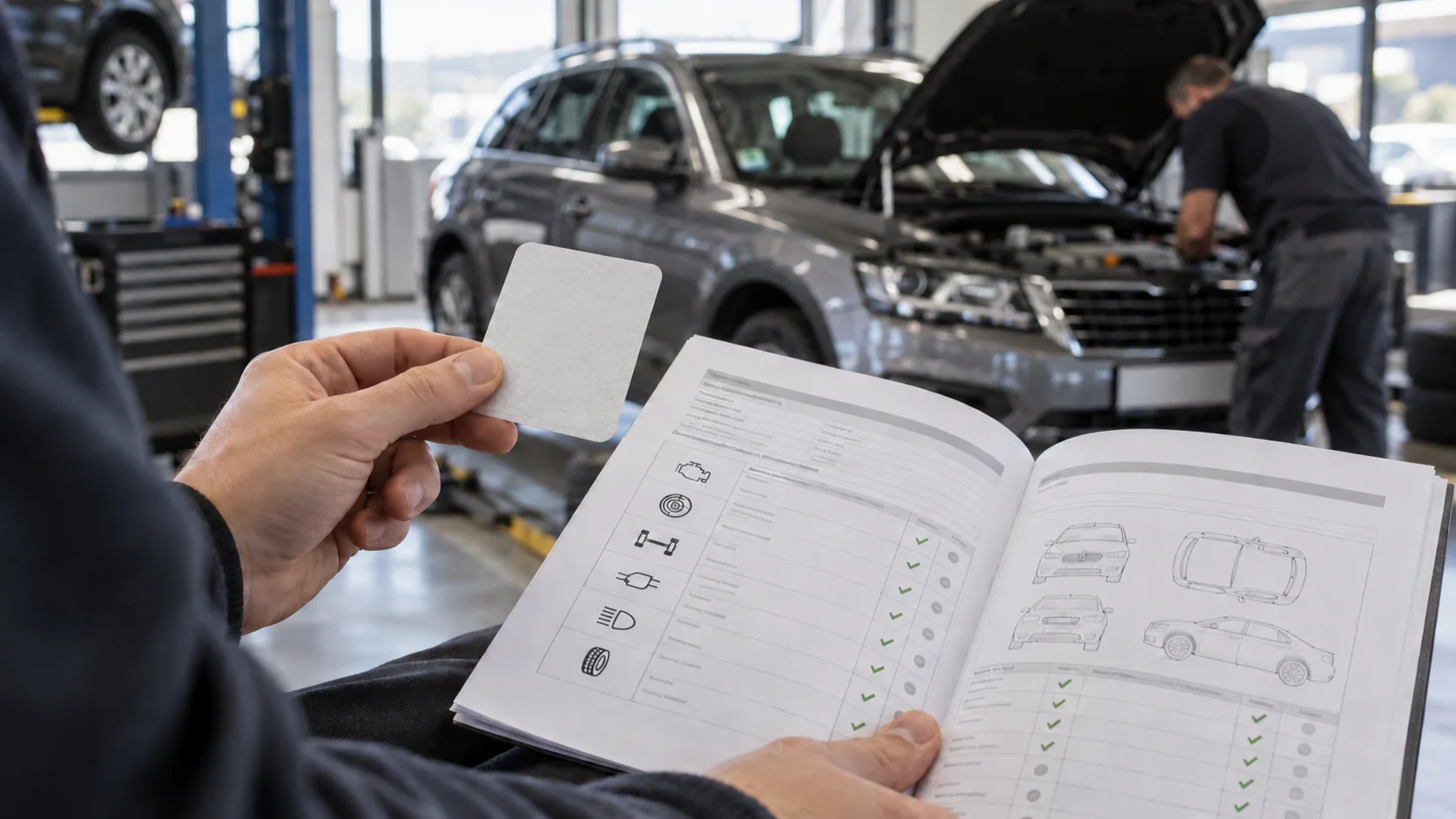
The official generic report has an English interface and Italian free-text technical notes; it does not concern your vehicle. 22
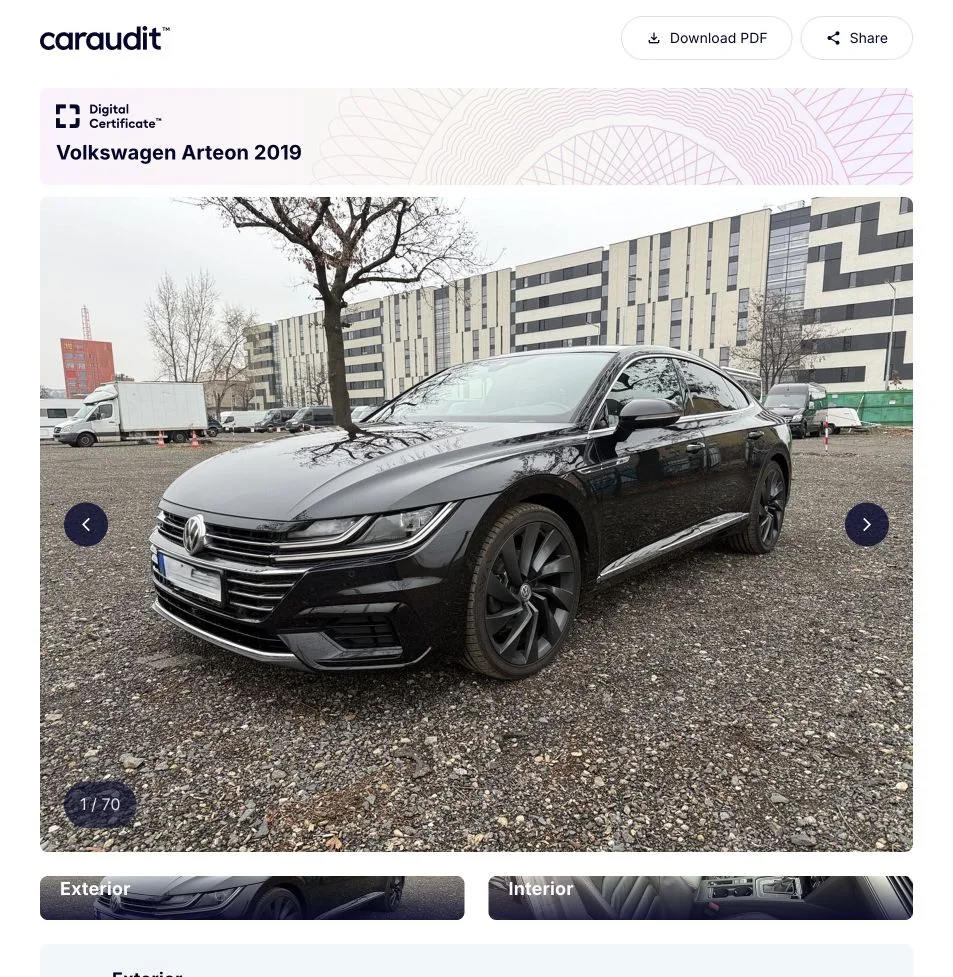
Official generic CarAudit inspection report sample
This generic sample has an English interface and Italian free-text technical notes. It does not concern your vehicle.
Pickerl, history and current condition are separate checks
A Pickerl records periodic inspection, replacing neither history checks nor a current purchase inspection. Travel abroad before the punched month ends: Austria's tolerance period is often unrecognised abroad. German HU evidence needs separate clarification. 18 Check mileage, maintenance invoices, repairs and unexplained gaps.
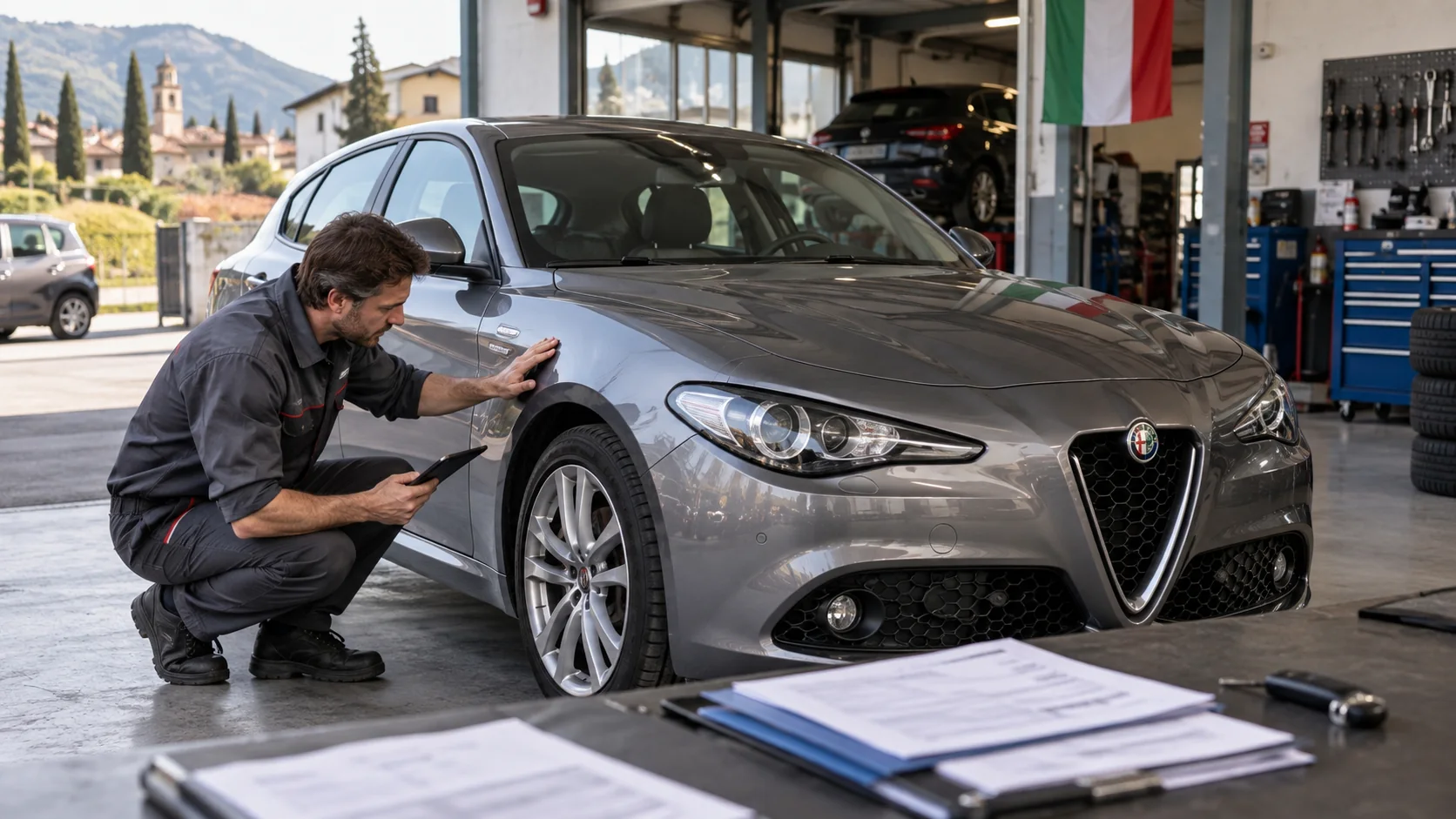
Inspect bodywork, underside, corrosion, tyres, brakes, suspension, fluid leaks, cold starting, drivetrain, assistance systems and diagnostics. Inaccessible components, no lift or no test drive must appear as inspection limits in the report.
CarAudit lists EUR 239 including technician travel for an accessible on-site Austrian inspection: up to 270 checkpoints, photos, report and purchase recommendation. These support buying, renegotiating or withdrawing, without guaranteeing every defect will be found or any appointment. 4 10 5
The decision table links documents, condition and registration risks; individual assessment remains necessary.
| Decision | Evidence needed | Reason to stop |
|---|---|---|
| Pay | VIN, seller identity, selling rights, contract and complete originals | Identity mismatch, missing authorisation or unresolved original |
| Accept condition | Report, photos, diagnostics and clear inspection limits | Unresolved material finding or refused access |
| Collect | Austrian deregistration or coordinated German registration under Article 15; clarify plates, insurance and route | Deregistration procedure, cover, recognition, driver or document handover unconfirmed |
| Register in Germany | CoC/expert report, specifically required HU evidence, eVB, SEPA and foreign originals | Part II, type approval or inspection evidence unresolved |
Austrian export: deregistration, driving or transport
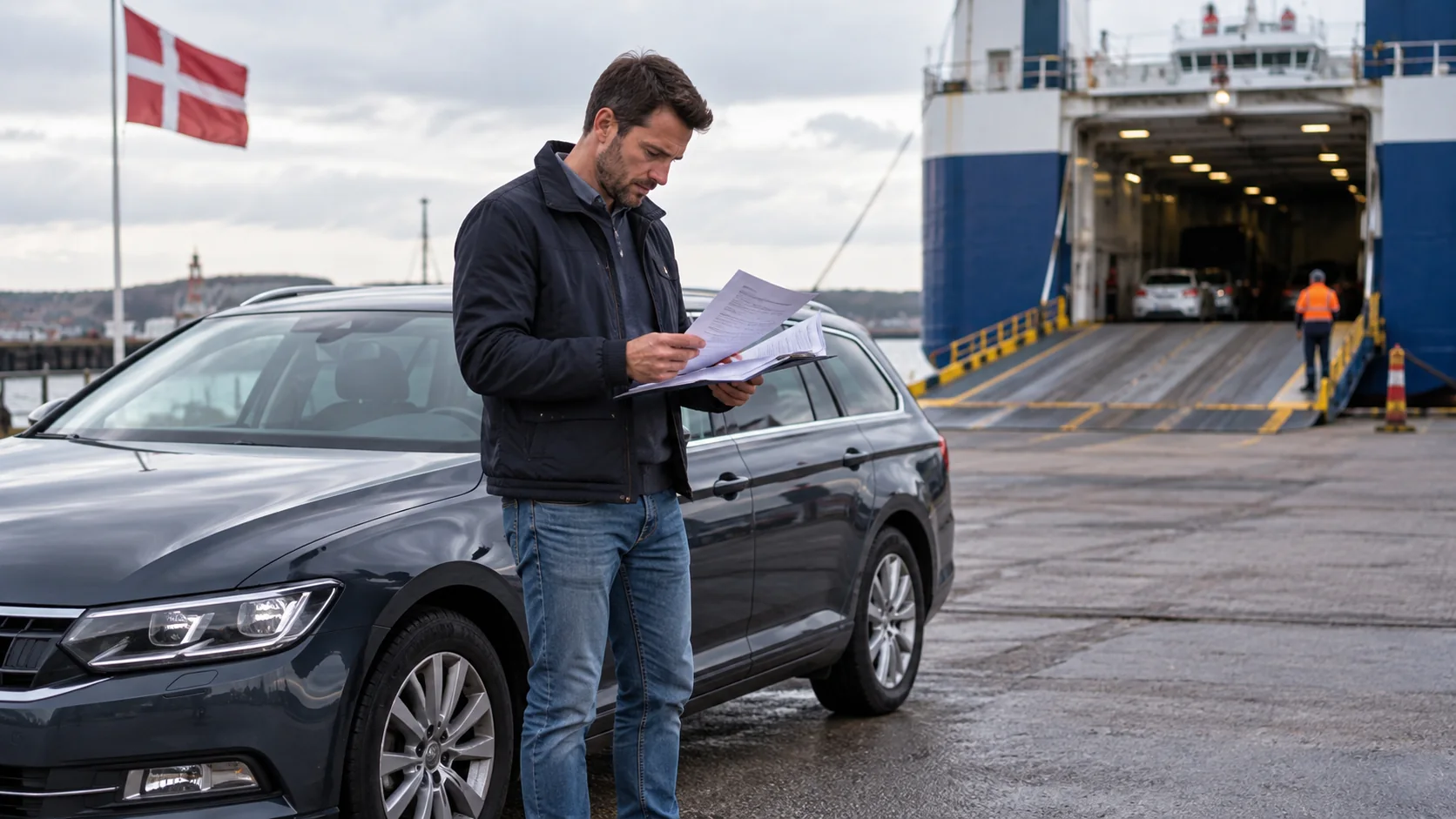
Austrian transfer plates last three to 21 days and require insurance. Obtain written confirmation of plates, drivers, territory and dates: Austrian validity alone proves neither recognition nor cover all the way to Germany. 1
The published EUR 248.60 comprises EUR 65.60 insurance administration, EUR 124 transfer-journey fee, EUR 23 plates and EUR 36 deposit. Returning plates within one year secures the deposit refund; the insurance premium is additional. 1 7
Ordinary Austrian deregistration requires both registration certificates, approval papers and plates. Alternatively, Article 15 of the German–Austrian treaty treats German registration as Austrian deregistration; documents and plates are retained against a receipt and forwarded. Coordinate your chosen procedure with both authorities beforehand; agree handover and confirmations in writing. 6 7 8
A refund of Austria's standard consumption tax (NoVA) is no buyer discount. For sales abroad, the seller transferring disposal rights normally claims. New rules apply to deliveries or transfers abroad from 1 July 2026; exports through 30 June retain the previous rules even if applications follow later. No more than 48 months may elapse between worldwide first registration and Austrian deregistration. Earlier foreign registrations count; intermediate deregistration does not restart the clock. Export needs separate evidence and determines the applicable law, not the period's endpoint.
The application must be filed within five years after delivery or transfer of the deregistered vehicle. It must be registrable at deregistration. A NoVA refund exceeding EUR 5,000 requires an appraisal of fair market value at Austrian deregistration: the threshold concerns the refund, not purchase price. VIN, database blocking, NoVA actually paid and no double relief under § 12a and § 12b are further conditions. Agree price, applicant, evidence and rejection risk separately. 19 20
| Option | Requirements | Cost and risk |
|---|---|---|
| Drive on Austrian transfer plates | 3 to 21 days, insurance and confirmation for the whole route | Published EUR 248.60; insurance premium additional |
| Trailer or vehicle transporter | Written order, collection access and handover record | Obtain provider-specific price and liability terms |
| Postpone collection | Originals, chosen deregistration procedure or safe legal driving arrangements missing | Prevents driving with unresolved legality or cover |
Compare documentation and transport risks when buying in Belgium (German guide), buying in Luxembourg (German guide) and buying in the Netherlands (German guide); their national rules do not transfer to Austria.
German VAT: new or used is a tax classification
Purchases from Austria incur no customs duty within the EU customs union. VAT, registration and transport remain separate. 7
For VAT, a land vehicle is new if mileage is no more than 6,000 kilometres or first use was no more than six months before acquisition. Used therefore requires over 6,000 kilometres and over six months. An advertised used car may remain fiscally new. A private buyer's intra-EU acquisition of a fiscally new vehicle attracts Germany's general 19 per cent rate; the actual tax depends on the statutory base, not a fixed sum here. 11 12 21
For fiscally used EU vehicles, distinguish seller type and VAT treatment. Private sales incur no VAT on the sale. Dealers may use ordinary VAT or the margin scheme; VAT may be separately shown or not. Cross-border carriage alone does not automatically trigger German acquisition VAT; no separate VAT entry alone does not establish margin taxation. 21 23
Have classification, mileage, first-use date, seller type and invoice wording checked before paying. Do not deduct assumed tax or NoVA refunds unilaterally.
HU, CoC and registration under FZV § 8
An EU-type-approved vehicle previously used in an EU/EEA state needs a German inspection under § 29 of the Road Traffic Licensing Regulations before registration if German intervals would make it due. A proven Directive 2014/45/EU inspection from the relevant EU/EEA state can replace it; subsequent deadlines follow German intervals. Missing first-use evidence requires a German § 29 inspection. Prior use outside the EU/EEA carries a separate mandatory German inspection. A Pickerl alone settles none of this. 3 2
Check CoC, technical data, Austrian inspection report and first use together. Without proven EU type approval, or with discrepancies, the registration office determines reports and evidence; modifications may require further inspections.
GebOSt lists EUR 30.00 as the registration/re-registration base fee. Plates, documents, modifications, inspections and surcharges are additional. 9 Annual German vehicle tax depends on engine capacity, CO2, powertrain and first registration, among other factors. 13
| Item | Amount | Condition |
|---|---|---|
| Purchase price, seller type and VAT treatment | To be determined | Contract/invoice, seller status and payment terms |
| German registration/re-registration base fee | EUR 30.00 | GebOSt 221.1; plates, documents, modifications and surcharges separate |
| Austrian transfer plates | EUR 248.60 | Includes EUR 36 deposit, refunded if plates returned within one year; insurance premium separate |
| CarAudit on-site inspection | EUR 239.00 | Standard location, technician travel included; access and availability required |
| Optional battery diagnostics | EUR 179.00 | Suitable electric/plug-in hybrids only; additional to base inspection |
| Optional Cebia Autotracer | EUR 23.90 | Additional to base inspection; findings depend on data coverage |
| Insurance and transport from Austria | To be determined | Driving and transporter are alternatives; price the specific route and cover |
| German VAT only for fiscally new EU vehicles | To be determined | 19 % of statutory base; only if no more than 6,000 km or no more than six months |
| HU, CoC/expert report and modifications | To be determined | Depends on vehicle, type approval and available evidence |
| Plates, documents and local extras | To be determined | Excluded from EUR 30.00 base fee |
| Annual German vehicle tax | To be determined | Engine capacity, CO2, powertrain, first registration and vehicle data |
Sources: 9 1 4 10 11 12 2 3 13
Close outstanding questions before the appointment
A sensible sequence prevents transport costs or time pressure dominating the purchase. Check identity, selling rights and originals, then history and condition. Next choose driving or transport; finally confirm VAT treatment and registration requirements with the authorities.
Four checks before irreversible payment:
| Close outstanding questions before the appointment | Progress |
|---|---|
| Match VIN, seller identity, authorisation or ownership and all originals. | Open |
| Compare inspection/maintenance history with mileage, invoices and actual condition. | Open |
| Choose driving or transport, coordinate prior Austrian deregistration or Article-15 procedure, and confirm plates and insurance throughout the route. | Open |
| Clarify CoC or expert report, specifically required HU evidence, eVB, tax details and German registration papers before collection. | Open |
Some evidence is still missing. Use the next steps listed.
With documents, seller type, VAT status, transport and registration consistent, arrange inspection before final payment or collection. Specify Austria as the actual vehicle location; confirm access, availability, lift and test drive for that car.
Frequently asked questions
Is a valid Pickerl enough to buy?
No. It replaces neither identity, history and condition checks nor German HU evidence. Travel before the punched month ends: Austria's tolerance period is often unrecognised abroad. 18 5
How long do Austrian transfer plates last?
At least three and at most 21 days, with insurance throughout. Recognition and cover for the entire route to Germany need separate confirmation. 1
Is EUR 248.60 the full driving cost?
No. The published sum includes a EUR 36 deposit, refunded only for plate return within one year; the insurance premium is separate. Distance and other travel costs are additional. 1 7
Does the German buyer automatically receive the NoVA refund?
No. The seller normally claims on sales abroad. For deliveries or transfers abroad from 1 July 2026, no more than 48 months may elapse between worldwide first registration and Austrian deregistration; intermediate deregistration does not restart this. The application must be filed within five years after delivery or transfer abroad of the deregistered vehicle. Evidence must cover deregistration, permanent export and registrability at deregistration, plus VIN and approval-database blocking. Double relief is excluded; refunds cannot exceed NoVA actually paid. Refunds over EUR 5,000 require an appraisal of fair market value as at Austrian deregistration. 19 20
When is a car still new for VAT?
If mileage is no more than 6,000 kilometres or first use was no more than six months ago. Used requires over 6,000 kilometres and over six months. 11 21
Is Austrian inspection evidence recognised in Germany?
German HU is required when due under German intervals. A proven Directive 2014/45/EU inspection from the EU/EEA state can replace it; German intervals then apply. Missing first-use evidence requires § 29 inspection. 3 2
Does German registration cost EUR 30 altogether?
No. EUR 30.00 is the statutory base item, excluding the full costs of plates, documents, inspections, technical changes, surcharges and local extras. 9
What does CarAudit inspection in Austria provide?
Subject to that vehicle's conditions: up to 270 checkpoints, photos, a detailed report and purchase recommendation. Standard price: EUR 239 including travel; seller access and availability remain prerequisites. 4 10 5
Must Austrian deregistration always precede German registration?
No. Prior Austrian deregistration is one option. Alternatively, Article 15 treats German registration as Austrian deregistration; documents and plates are forwarded against a receipt. Coordinate with both authorities. 7 8
Sources
- oesterreich.gv.at — Transfer plates
- Bundesportal — Zulassung eines gebrauchten Kraftfahrzeuges aus einem EU-
- FZV § 8 — Zulassung nach vorheriger Zulassung in einem anderen Staat
- CarAudit Deutschland — Leistung, Preis, Optionen und Länder
- CarAudit Deutschland — Was wir prüfen
- oesterreich.gv.at — Kfz-Abmeldung
- oesterreich.gv.at — Überstellung in ein anderes EU-Land
- DE–AT Verwaltungshilfevertrag — Artikel 15
- GebOSt Anlage — Gebührennummer 221
- CarAudit Deutschland — FAQ
- UStG § 1b — innergemeinschaftlicher Erwerb neuer Fahrzeuge
- UStG § 12 — Steuersätze
- Zoll — Übersicht zur Kraftfahrzeugsteuer
- CarAudit Deutschland — Bestellung
- Carvago Deutschland — Fahrzeugkatalog
- Carvago Deutschland — Kaufprozess
- Carvago Deutschland — Lieferung
- oesterreich.gv.at — Begutachtung (Pickerl)
- BMF — NoVA-Rückvergütung
- BMF — NoVA §12a/§12b from 1 July 2026
- Your Europe — VAT when buying or selling a car abroad
- Official CarAudit generic sample report
- UStG § 25a — Differenzbesteuerung