Bringing a car from Sweden to Germany: check vehicle debts, original documents, export registration, insurance, roadworthiness and costs before buying.
Before paying, check the vehicle’s identity, original documents, the seller’s authority to sell and any vehicle debts. Then have its condition assessed and plan export, insurance and German registration together. This advice is for private buyers in Germany purchasing a used car already registered in Sweden. You can compare other countries of origin in the guide to buying a car abroad (in German).
Check documents and debts first
The registreringsbevis, Sweden’s registration certificate, has Parts 1 and 2. Part 1 contains technical data, user/owner details and leasing information; Part 2 goes to the registered owner or lessor for ownership transfers and deregistration. A replacement invalidates the previous version. Compare the vehicle identification number (VIN) on the car with both current originals, the contract and the seller’s identification. Where a representative, lease or finance is involved, obtain the appropriate authorisation or release: the register entry alone does not prove authority to sell. 1 10
Unpaid vehicle tax, congestion charges, infrastructure charges and public parking charges, including surcharges, can affect the car. The person recorded when the charge was assessed generally remains personally liable. Kronofogden, the Swedish Enforcement Authority, first attempts to collect from the debtor, but may then seize the vehicle even after it has been sold. Also check for an användningsförbud, a prohibition on using the vehicle. 3 26
Open Fordonets skulder (“vehicle debts”) together; the seller uses their own electronic identification or the vehicle authorisation code. Neither Transportstyrelsen nor Kronofogden can provide a completely up-to-date total because charges take time to appear. Additional enforcement costs do not appear at Transportstyrelsen: clarify transferred cases with Kronofogden, request payment receipts, ask about unrecorded charges and check again immediately before payment. An old screenshot is insufficient. 3
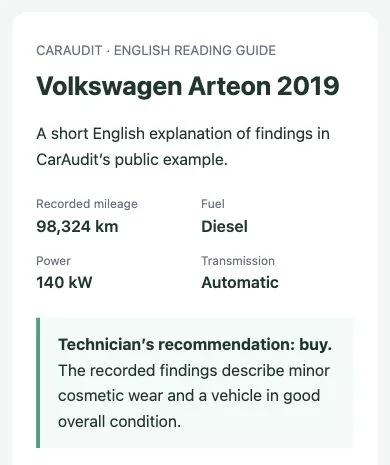
Example: Volkswagen Arteon 2019, 98,324 km, 140 kW, diesel, automatic.
Editorial English reading guide to the public example. Original: English navigation and Spanish technician notes; not the reader’s vehicle.
Consider the history alongside today’s condition
Compare mileage readings, previous registration countries, inspection reports, and maintenance and repair records. A Swedish location does not prove an exclusively Swedish history; missing records do not prove the car is accident-free. Sweden’s periodic kontrollbesiktning, a vehicle roadworthiness inspection, and a recommended pre-purchase inspection answer different questions. 25
Have repair traces, paintwork in the context of adjacent panels, the underbody and corrosion, structural areas, pipes and lines, brakes, tyres, drivetrain and leaks assessed. A universal paint-thickness threshold proves neither an accident-free history nor accident damage. Arrange a lawful, insured test drive and diagnostics. A fault code is not a repair quotation; an empty fault memory does not confirm that the car is free of defects. Battery readings such as State of Health (SoH, battery condition) need to be interpreted in relation to the model and measurement method. If a test important to a particular finding is missing, resolve this before buying. 4 25
Record the price, currency, mileage, known defects, documents, keys, payment terms and handover arrangements in the contract. Clarify seller status (private seller or dealer), invoice type and applicable rights; living in Germany alone does not determine every warranty rule. 2
| Finding | Decision |
|---|---|
| Identity, authority to sell or originals unresolved; a transfer obstacle exists | Pause payment and departure; obtain evidence or clearance. |
| Debts/use prohibition unresolved | Clarify with the seller and authorities; check again before paying. |
| Serious technical finding unresolved | Obtain an inspection and repair quotation; a discount does not remove the obstacle. |
Drive it home or have it carried as a load?
Swedish export registration needs preparation before you travel. When comparing alternative offers, also consider the paperwork and travel involved in buying a car in Denmark (guide in German) or buying a car in Finland (guide in German).
| Option | Confirm before departure |
|---|---|
| Drive it yourself | Confirm the actual plates, registration, roadworthiness permission and insurance for Germany/transit countries. |
| Carried on a transporter/trailer | Agree a transport quotation and evidence of actual export; organise Swedish deregistration. |
Apply for temporary export registration
As a buyer permanently resident outside Sweden, you can apply; the seller applies for deregistration at the same time. Registration lasts one calendar month from the decision, rather than collection, cannot be extended and requires export within that month. The decision, new registration certificate and special plates with a new registration number are posted to a Swedish postal address. Allow time for delivery and carry the decision when driving. 5 27
The application requires the appropriate proof of insurance, the current original Part 2 signed by the seller for deregistration, and the existing Swedish plates; the seller is responsible for the originals and old plates. Attach proof of a passed inspection if it is not recorded in the register. Before posting anything, agree which originals and new documents Germany will need; arrange copies and handover. 14 29 8
The last passed Swedish inspection must have taken place no more than twelve months before the application. There must be no disqualifying debt-related use prohibition, relevant subsequent driving ban or inspection order. A driving ban for an overdue inspection that will arise within one month after receipt of the complete application also prevents approval. Chapter 11 §§ 11–12 of the Swedish transport regulations governs this; the older description of the relevant date in the form does not replace that rule. 30 10
Align insurance dates and cover for the entire route
For export to the European Union (EU) or European Economic Area (EEA) within 30 days of acquisition in Sweden, a 30-day insurance certificate from Sweden or the destination country, Germany here, can be used. Once more than 30 days have elapsed since acquisition, Swedish third-party liability insurance evidence is required for temporary registration. 14
One calendar month of registration is not equivalent to 30 days of insurance; their start dates also differ. From day 31 after the certificate starts, follow-on Swedish insurance may be needed. Confirm the precise dates and cover for Germany and every transit country. Do not assume the seller’s policy or the elektronische Versicherungsbestätigung (eVB, electronic insurance confirmation) for subsequent German registration covers the journey home. 5
Prove actual export and arrange deregistration
Without granted temporary export registration, deregistration requires notification, evidence of permanent export and the old plates. For the EU/EEA, use the designated form or a copy of both sides of the current Part 2. Suitable evidence includes a German registration certificate/authority confirmation or a professional carrier’s certificate confirming actual export to Germany. A contract, receipt or invoice alone is insufficient. The seller must submit complete documents; until deregistration, they remain registered and generally liable for tax and insurance unless the vehicle is subject to an off-road notification. German registration does not ensure automatic Swedish deregistration. 6
If German registration takes place before export registration expires, notify Transportstyrelsen in writing that temporary registration is ending and have the procedure for the special plates confirmed against the decision. On normal expiry, destroy them. 14 5 8
German registration, roadworthiness inspection and VAT
Before buying, clarify the required documents with your registration authority. Berlin, as a local example, lists an application, proof of identity, purchase contract/invoice, original foreign documents and existing plates, eVB and a SEPA direct debit mandate for vehicle tax (SEPA: Single Euro Payments Area). For type-approved vehicles, technical data can come from a CoC (Certificate of Conformity) or manufacturer’s confirmation. A missing CoC alone does not require an expert report under § 21 of the Straßenverkehrs-Zulassungs-Ordnung (StVZO, German Road Traffic Licensing Regulations); without type approval, this separate assessment applies. If Part 2 of a two-part foreign certificate is actually missing, § 8 of the Fahrzeug-Zulassungsverordnung (FZV, German Vehicle Registration Regulations) requires confirmation from the foreign authority via the Kraftfahrt-Bundesamt (KBA, German Federal Motor Transport Authority). 19 18 31 32
For EU-type-approved vehicles previously used in the EU/EEA, an inspection under § 29 StVZO is required before registration if it would be due under German intervals. A proven inspection report complying with Directive 2014/45/EU from the EU/EEA country of use can replace it; the next deadline follows German intervals. Without proof of first use, the German inspection is mandatory; previous use outside the EU/EEA separately triggers a mandatory inspection. For ordinary privately used passenger cars, the first Hauptuntersuchung (HU, periodic roadworthiness inspection) is after 36 months, then every 24 months; special uses have different intervals. 18 28
For VAT purposes, a car is new if, at acquisition, it has no more than 6,000 km or no more than six months have passed since first use. To count as used, both thresholds must have been exceeded. German private buyers acquiring a vehicle that is new for tax purposes from another EU country owe 19% on the statutory taxable amount. Under § 18 paragraph 5a of the German Value Added Tax Act, they must calculate, declare and pay the tax themselves, no later than the tenth day after the day the tax liability arose; personally sign paper declarations. Agree the date and filing method with the tax office before buying; do not wait for registration. 15 33 16 17
A private sale of a car that is used for tax purposes attracts no VAT on the sale. Dealers may invoice under ordinary VAT rules or the margin scheme; an absence of separately stated VAT does not by itself establish which applies. Moving the car across the border does not automatically mean German acquisition VAT or a net-price purchase. No customs duty applies to the ordinary intra-EU Sweden–Germany case. 15 34
Complete your budget before committing
Compare the purchase price, including currency-exchange costs, with condition and logistics. For offers closer to home, the comparison with buying a car in Austria (in German) can also help. Swedish amounts are in Swedish kronor (SEK). The following items do not constitute a total; choose between driving the car yourself and having it carried as a load. Budget separately for ongoing German tax and insurance.
| Item | Amount | When does it apply, or how is it established? |
|---|---|---|
| German basic registration/re-registration fee | 30 EUR | Basic fee under the German schedule of road-traffic administration fees; plates, additional documents/changes separate. |
| Data retrieval surcharge | 15.30 EUR | Only if KBA data cannot be retrieved AND are absent from the local register. |
| Chosen registration number | 10.20 EUR | Only for a number selected outside normal allocation. |
| Exchange of old Fahrzeugbrief document | 5.10 EUR | Only for exchanging an old Fahrzeugbrief vehicle document for registration certificate Part 2. |
| Interchangeable registration plates | 6 EUR | Only when interchangeable registration plates are allocated. |
| Swedish temporary export registration: application | 0 SEK | Registration itself only; plates, insurance and transport separate. |
| Swedish plate fee per plate | 62 SEK | Per plate; number and fee liability depend on the specific procedure. |
| Swedish annual register fee | 74 SEK | Annual rate; only where liability and payment due actually apply. |
| CarAudit on-site inspection in Sweden | 329 EUR | Sweden selected; includes VAT and technician travel. |
| Optional CarAudit battery diagnostics | 179 EUR | Optional extra for suitable electric/plug-in hybrid vehicles. |
| Optional Cebia Autotracer | 23.90 EUR | Optional extra; available history data depend on the vehicle. |
| Purchase price and invoice type | To be determined | To be determined: contract, currency, seller status/invoice type, exchange costs. |
| Insurance for the journey home | To be determined | To be determined: insurer, acquisition date, period and route. |
| Travel, ferry/bridge, fuel and tolls | To be determined | To be determined: route/date; alternative to a transporter. |
| Professional transport with the car carried as a load | To be determined | To be determined: addresses, vehicle, date, export evidence. |
| German VAT on a vehicle that is new for tax purposes | To be determined | To be determined: 19% of the statutory taxable amount, only if new for tax purposes; tax office. |
| HU, CoC/manufacturer data and technical modifications | To be determined | To be determined: vehicle documents/inspection report with the authority and inspection centre. |
| German plates and additional documents | To be determined | To be determined: plate supplier, registration authority, documents. |
| Specific repairs | To be determined | To be determined: specific finding and workshop quotation. |
| German annual vehicle tax | To be determined | Determine separately: powertrain, engine capacity, CO₂, first registration. |
| Ongoing German insurance | To be determined | Determine separately: insurer, vehicle, driver/tariff. |
Sources: 7 5 8 9 10 11 12 13 2 14 6 15 16 17 18 19 4 20
For Swedish plates, the actual number and the fee liability of the owner registered at the relevant time matter: Chapter 10 § 4 of Registration Regulation 2019:383 refers to Chapter 3 §§ 5–8. The annual register fee depends on the owner, liability for the charge and when it falls due; it is not automatically added to every export application. 10 9
Four stages before payment and collection
Complete these four stages before payment and collection; the evidence is explained in the relevant sections.
| Four stages before payment and collection | Progress |
|---|---|
| Check the VIN, current original documents, seller’s authority and vehicle debts together. | Open |
| Compare the history and Swedish inspection reports with the car’s condition today. | Open |
| Arrange export documents and an insured drive home or transport with the car carried as a load before collection. | Open |
| Clarify German roadworthiness, tax and registration documents, and complete your own budget. | Open |
Some evidence is still missing. Use the next steps listed.
Frequently asked questions
Do I personally take over the previous owner’s debts?
The original debtor generally remains liable to pay. After an unsuccessful attempt to collect from them, Kronofogden, the Swedish Enforcement Authority, may still seize the car after it has been sold; also check for a prohibition on using it. 3 26
Is an empty debt balance always up to date?
No. Delays in recording charges and additional enforcement costs prevent a fully current total. Check together live, request receipts, and clarify unrecorded charges and transferred cases. 3
How long does Swedish export registration last?
One calendar month from the decision, with no extension; export within that period. Collection does not start a new period. Check insurance dates separately. 27 5
Why are one month and 30 days of insurance different?
Registration and the policy may start on different dates. Within 30 days of acquisition, export to the European Union (EU) or European Economic Area (EEA) can use a Swedish or German 30-day insurance certificate; afterwards, Swedish third-party liability insurance evidence is needed. From insurance day 31, clarify whether follow-on Swedish cover is required. 14 5
Is the purchase contract sufficient evidence of export?
No. Without temporary export registration, notification, proof of actual export and the old plates are needed. Suitable evidence includes German registration/authority confirmation or a professional carrier’s certificate of completed export to Germany. 6
What should I report if I register the car in Germany early?
Notify Transportstyrelsen in writing that temporary registration is ending; handle the special plates according to the decision and confirmed authority instructions. Destroy them on normal expiry. 5 14 8
Can the Swedish inspection be recognised for the German HU?
Under § 8 of the Fahrzeug-Zulassungsverordnung (German Vehicle Registration Regulations), the following applies to a vehicle with European Union (EU) type approval previously used in the EU or European Economic Area (EEA): if the Hauptuntersuchung (HU, periodic roadworthiness inspection) would be due under German intervals, § 29 of the Straßenverkehrs-Zulassungs-Ordnung (German Road Traffic Licensing Regulations) applies. A proven inspection under Directive 2014/45/EU from the EU/EEA country of use can replace it; the next deadline follows German intervals. Without proof of first use, a German § 29 inspection is mandatory; previous use outside the EU/EEA separately triggers this requirement. Ordinary private passenger cars: first after 36 months, then every 24 months; special uses differ. 18 28
When is the car new for tax purposes, and when must I pay?
At acquisition, no more than 6,000 km OR no more than six months since first use means new for tax purposes, with 19% for German private buyers. To count as used, both thresholds must have been exceeded. § 18 paragraph 5a of the German Value Added Tax Act requires self-assessment, declaration and payment by the tenth day after the day the tax liability arose; personally sign paper declarations. Clarify the date with the tax office, independently of the registration appointment. 15 16 17
What if Part 2 or the CoC is missing?
A missing foreign Part 2 requires authority confirmation via the Kraftfahrt-Bundesamt (German Federal Motor Transport Authority). A missing CoC (Certificate of Conformity) alone does not mean a § 21 expert report is required; where type approval exists, manufacturer confirmation is one possible option. Without type approval, the separate assessment applies. Clarify with the registration authority before buying. 18 19
Have your chosen car inspected
Sources
- Transportstyrelsen — Registration certificates
- ADAC — used EU car purchase advice
- Transportstyrelsen — Fordonsrelaterade skulder
- CarAudit Deutschland — Was wir prüfen
- Transportstyrelsen — Temporary registration for used export
- Transportstyrelsen — Export and deregistration
- GebOSt Anlage — Gebührennummer 221
- TS8028 — export used vehicle form Version2
- TSFS2024:78 consolidated — chapter30 fees
- SFS2019:383 — registration regulation
- Transportstyrelsen — plate and registry fees
- CarAudit — Sweden selected actual DE form
- CarAudit Deutschland — Leistung, Preis, Optionen und Länder
- Transportstyrelsen — Tillfällig registrering vid export begagnat
- Your Europe — VAT when buying or selling a car abroad
- UStG § 12 — Steuersätze
- UStG18(5a) — individual vehicle taxation
- FZV § 8 — Zulassung nach vorheriger Zulassung in einem anderen Staat
- Berlin — EU/EEA used vehicle registration
- Zoll — Übersicht zur Kraftfahrzeugsteuer
- CarAudit — German order entry
- Carvago global vehicle selection directory
- CarAudit — Sweden selected actual English form
- CarAudit Deutschland — FAQ
- TÜV NORD — AutoKaufCheck
- Kronofogden — vehicle with unpaid debts
- SFS2019:370 — vehicle registration and use, §17
- StVZO Anlage VIII
- Transportstyrelsen — application TS8028
- TSFS2015:63 consolidated, chapter11 §§11–12
- European Commission — Single Euro Payments Area
- Bundesportal — Zulassung eines gebrauchten Kraftfahrzeuges aus einem EU-
- UStG § 1b — innergemeinschaftlicher Erwerb neuer Fahrzeuge
- UStG § 25a — Differenzbesteuerung