Importing a used Swiss car into Germany: check original documents, condition, origin, customs duty, import VAT and registration before paying.
For a private buyer resident in Germany, a used Swiss car is an import from a third country. Before paying, clarify the original documents, seller status, vehicle condition, export, import charges and German registration. A car is not automatically exempt from customs duty and import value added tax (VAT) simply because it is used or bought privately. 11
This concerns an ordinary used passenger car, the direct Swiss–German border crossing and import clearance in Germany. A different first point of entry into the European Union (EU) needs its own customs or transit plan. Removal goods, returned goods, collectors’ vehicles and special tariff cases require separate assessment. You can explore other purchasing routes in the guide to buying a car abroad (in German). 11
Check the original documents and seller first
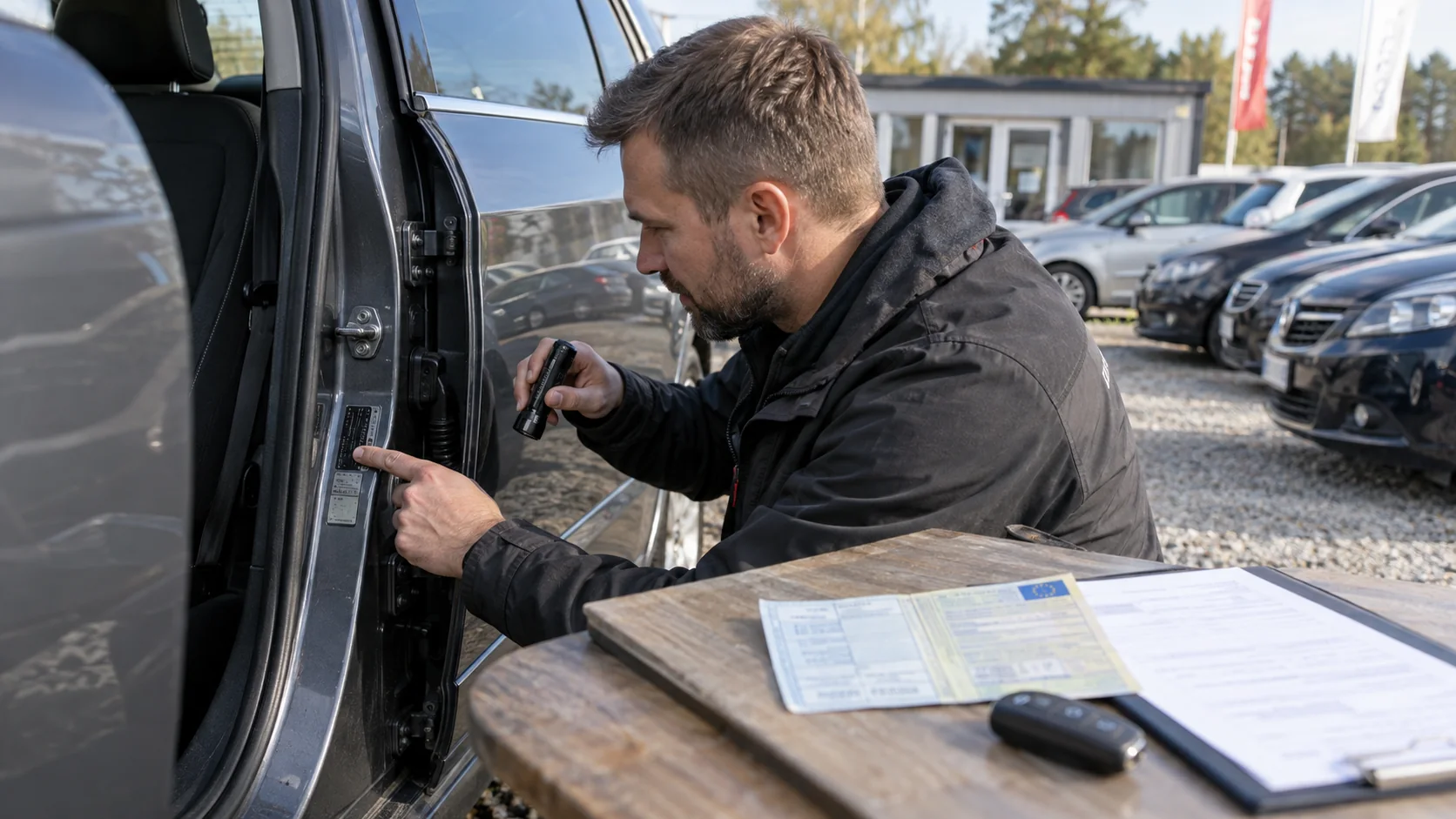
Compare the vehicle identification number (VIN) on the car with the Swiss registration document (Fahrzeugausweis) and proof of purchase. Check the seller’s identity and authority to dispose of the vehicle; request a power of attorney and finance release where relevant. Ask for maintenance invoices, repair records and reports from the Swiss roadworthiness inspection (Motorfahrzeugkontrolle, MFK). Put the dates and mileage in order. An absence of damage reports does not prove that the car is accident-free. Send the technical documents to your German registration authority before buying. 12
Clarify seller status, invoice type, the contracting party and applicable law. German residence does not automatically mean German warranty terms apply. Record defects, missing documents, accessories, keys, promised work and handover mileage in writing. If identity, authority to dispose of the car or serious findings remain unresolved, we recommend suspending payment and collection. 12
Switzerland is absent from the public German and English order-country lists checked. Arrange an inspection for your location through an individual enquiry. 1617
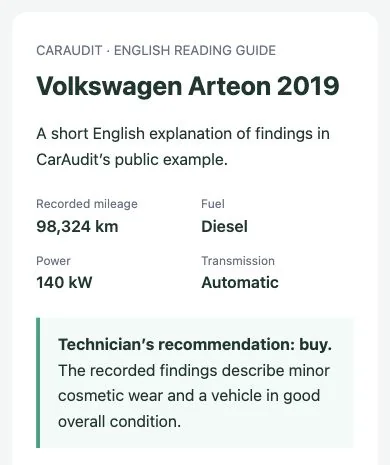
Volkswagen Arteon, 2019, 98,324 km, 140 kW, diesel, automatic. Public example; not your vehicle.
Editorial English reading guide to the public example. Original: English navigation and Spanish technician notes; not the reader’s vehicle.
Compare the history with the car’s current condition
A current independent inspection helps put the advert and history into perspective. Have the bodywork and paint assessed in the context of the material, panel and signs of repairs. A general paint-thickness threshold does not prove that a car is accident-free. The assessment should also cover underbody corrosion, axles, suspension, brakes, tyres, drivetrain, leaks and a cold start. Photographs should clearly show areas of concern. 2
Plan a lawful, insured test drive and diagnostics. A fault code is not a repair quotation; an empty fault memory does not prove that the car is free of defects. For electric cars, a battery result needs information about the measurement method and test conditions. A single reading is not a forecast of service life. 2
| Finding | Decision before payment |
|---|---|
| Unresolved identity, authority or original documents | Suspend payment; check the evidence and consult the authority. |
| Serious unexplained technical finding | Clarify the cause and workshop costs; postpone the purchase decision. |
| Preference not yet substantiated | Do not budget customs duty as zero; obtain proof. |
Clarify preferential origin before export
Buying a car in Switzerland, Swiss registration or the vehicle’s make does not establish preferential origin. A customs concession requires compliance with the origin rules, valid proof and its acceptance by the importing customs authority. The Swiss exporter must prepare the proof before export. Until this is resolved, do not budget customs duty as zero. 43
Possible documents are the EUR.1 movement certificate or a permitted origin declaration on an invoice or suitable commercial document. Under the normal procedure, the limit of EUR 6,000 or CHF 10,300 applies to the ex-works value of the qualifying originating products in a consignment. An arbitrary advertised total is not the deciding value. The prescribed wording, evidence of origin and, as a rule, a handwritten signature are required. Authorised exporters may make declarations under their authorisation without this value limit and are exempt from the handwritten signature requirement. The EUR-MED movement certificate has not been provided for under the revised pan-Euro-Mediterranean origin convention since 1 January 2026. 183
The Certificate of Conformity (CoC), the European Community (EC) certificate of conformity, instead concerns technical registration requirements. It does not replace proof of preferential origin. 13
Organise Swiss export and collection
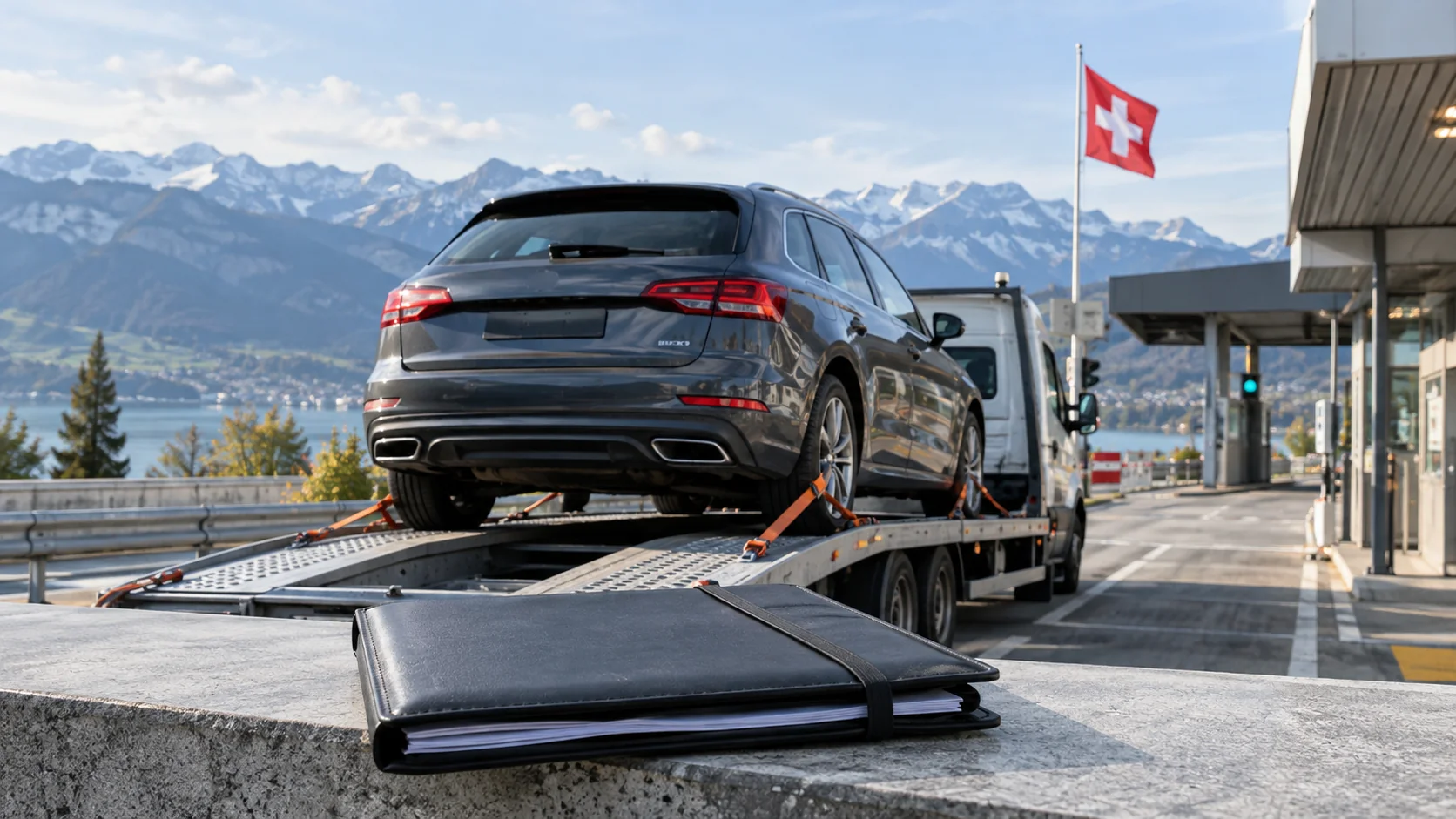
Declare the permanent export on your own initiative at a Swiss customs office responsible for commercial goods. You need the original Fahrzeugausweis, even if it has already been cancelled, proof of identity, an electronic export customs declaration through e-dec and, where applicable, proof of origin. This does not make prior cancellation a general customs prerequisite. Agree who is responsible for the declaration and check commercial-goods clearance opening hours before travelling. 4
| Option | Confirm before booking |
|---|---|
| Driving the car yourself | Cantonal export plates: validity, registration status, roadworthiness and insurance for the entire route. |
| Carried on a vehicle transporter | Quotation for the exact car, collection point, destination and transport insurance; assign responsibility for customs clearance. |
Sources: 4
The seller’s plates and existing insurance do not automatically remain valid. Coordinate deregistration and handover; document the condition, mileage, keys and original documents. For an alternative offer in Italy, the guide to buying a car in Italy (in German) helps assess the collection journey and documents required. You can compare an offer near the border using the guide to buying a car in Austria (in German). 4
Calculate German import charges correctly
Swiss export clearance does not complete the German import process. The common EU standard customs duty rate for ordinary passenger cars is 10%. Check the specific tariff classification, preference, reliefs and any additional vehicle-specific duties. German import VAT is 19%. 11108
The customs value generally includes the purchase cost and relevant transport and insurance to the EU customs frontier. Under section 11 of the German VAT Act, import VAT is calculated on the customs value plus customs duty and further statutory items, insofar as they are not already included: in particular, transport and other services to the first EU destination and to a further EU destination already known when the tax liability arises. Foreign levies and excise duties may also be included where applicable. Customs currency-conversion rules apply to foreign currencies. Adding 10% and 19% to the same advertised price does not produce a correct calculation. 108
Clarify the import declaration, assessment, payment and release with the German clearance office before travelling. Payment deferral under section 21 of the German VAT Act requires authorisation; private buyers do not receive an automatic deferral until the 26th day. Keep clearance and payment records for registration. 121
Swiss VAT requires an agreement
Agree the gross payment, any refund, export evidence and conditions in writing with a VAT-registered dealer. Direct export without intervening use forms part of the relevant exemption scenario. The Swiss Federal Tax Administration is the competent authority. The electronically signed export assessment decision serves as proof of export and must be retained electronically. Do not deduct a refund on your own initiative; an ordinary private sale has no corresponding dealer refund. 719
Prepare German registration and roadworthiness inspection
Switzerland is outside the EU and the European Economic Area (EEA). For an EU-type-approved vehicle previously used there, section 8(3) of the German Vehicle Registration Regulation requires an inspection under section 29 of the German Road Traffic Licensing Regulations before German registration. The Swiss MFK does not automatically replace this German main roadworthiness inspection (Hauptuntersuchung, HU). The usual passenger-car intervals of an initial 36 months and then 24 months do not waive this requirement. 1320
Technical approval needs to be clarified separately. Berlin, for example, requires an expert report under section 21, no more than 18 months old, with a technical data sheet, or conditionally a CoC or manufacturer’s data confirmation: the latter documents suffice only if the Swiss vehicle documents show that the EC type-approval number was recognised for registration there. Deviations may require an exemption permit. A missing CoC does not automatically mean a section 21 report is needed, and having a CoC does not guarantee registration. 1
Prepare the original vehicle papers, proof of acquisition or authority to dispose of the car, identification, electronic insurance confirmation (eVB), a SEPA direct-debit mandate for vehicle tax, customs evidence and a valid HU. SEPA stands for Single Euro Payments Area. Berlin informs the main customs office if the customs clearance certificate is missing. Only where a foreign registration certificate actually has two parts does a missing Part II require confirmation of previous registration from the foreign authority through Germany’s Federal Motor Transport Authority (Kraftfahrt-Bundesamt, KBA). Clarify what is needed using the actual original documents. 113
Compare the costs of getting the car ready to use
Replace “to be determined” with vehicle-specific quotations. The national base fee and Berlin minimum fee are alternative reference amounts. Driving the car yourself and transporting it are alternative solutions; recurring tax and insurance are listed separately. You can assess a comparable French offer using the guide to buying a car in France (in German).
| Cost item | Amount | Condition / how to determine it |
|---|---|---|
| German base registration/re-registration fee | EUR 30.00 | National base fee under the fee schedule, item 221.1; not a total price. An alternative to the Berlin minimum fee. |
| Data-retrieval surcharge | EUR 15.30 | Only if data cannot be retrieved from the Federal Motor Transport Authority (KBA) AND are absent from the local register. |
| Chosen registration number | EUR 10.20 | Only when choosing a number outside the regular allocation. |
| Exchange of the Fahrzeugbrief vehicle document | EUR 5.10 | Only when exchanging a Fahrzeugbrief for Part II of the registration certificate. |
| Interchangeable registration plates | EUR 6.00 | Only when interchangeable registration plates are allocated. |
| Berlin third-country registration: local minimum fee | EUR 34.70 | Berlin example in the least expensive case; the actual case may cost more. Alternative to EUR 30; plates/exemptions extra. |
| Swiss export customs duty | CHF 0.00 | Swiss export only; German import charges are separate. |
| Standard official Swiss export clearance | CHF 0.00 | Generally free; special services, out-of-hours clearance and agents cost extra. |
| Purchase price under the contract/invoice | To be determined (CHF) | Contract: gross payment, seller status, invoice type; agree any dealer refund separately. |
| Currency conversion and payment/bank charges | To be determined (EUR) | Ask the bank for a quotation/exchange rate; clarify customs conversion separately. |
| Individually confirmed inspection in Switzerland | To be determined (EUR) | Enquire about the car/location; confirm availability, scope, price and timing. |
| Proof of preference and any preliminary examination | To be determined (CHF) | Exporter/customs: clarify suitable proof and any preliminary examination fee. |
| Swiss customs agent/additional official service | To be determined (CHF) | Request the agent’s quotation and special-service/out-of-hours charges. |
| Cantonal export plates and insurance for the full route | To be determined (CHF) | Canton: confirm price, validity, registration status and insurance to the German destination; alternative to transport. |
| Carriage on a vehicle transporter | To be determined (EUR) | Quotation for car, collection point, destination and insurance; alternative to driving it yourself. |
| Travel, fuel, accommodation and collection | To be determined (EUR) | Determine costs for the selected route only. |
| German import customs duty: ordinary passenger-car standard rate | To be determined (EUR) | 10% of the applicable customs value; check classification, preference, relief and additional charges. |
| German import VAT | To be determined (EUR) | 19% on customs value plus customs duty and statutory additional items insofar as not already included; consider the first/further known EU destinations. |
| German customs clearance/freight agent | To be determined (EUR) | Obtain a quotation for declaration, payment, release and agent’s fee before travelling. |
| German main roadworthiness inspection | To be determined (EUR) | Ask the inspection centre for its price; German HU is required under section 8(3); MFK is not an automatic replacement. |
| CoC/data confirmation or section 21 report and modifications | To be determined (EUR) | The registration authority checks originals; conditional CoC/manufacturer’s data or section 21 report (Berlin: no more than 18 months old); obtain modification quotations. |
| Exemption permit, if applicable | To be determined (EUR) | Only if required: ask the authority about the exemption and fee. |
| German number plates and additional documents | To be determined (EUR) | Ask the plate supplier/registration authority; excluded from Berlin’s minimum fee; avoid double counting. |
| Documented repairs and maintenance | To be determined (EUR) | Assess findings/photos using a workshop quotation; a fault code is not a cost calculation. |
| Annual German vehicle tax | To be determined (EUR) | Enter vehicle data, first registration, propulsion, engine capacity and CO₂; keep annual tax separate. |
| German insurance | To be determined (EUR) | Obtain an individual quotation and electronic insurance confirmation (eVB); keep recurring insurance separate. |
Sources: 5 1 6 7 8 9 3 4 10 11 12 13 2 14
Four stages before payment
Clarify these four stages before payment and collection; the relevant section gives the details.
| Four stages before payment | Progress |
|---|---|
| Compare the VIN, seller’s authority, Swiss registration document and proof of purchase. | Open |
| Compare the history and Swiss roadworthiness inspection with current condition and documented findings. | Open |
| Organise Swiss export, proof of preference and insured self-drive collection or transport. | Open |
| Clarify German import charges, main roadworthiness inspection and registration documents, together with a complete budget. | Open |
Some evidence is still missing. Use the next steps listed.
Common questions about buying a Swiss car
Is customs duty waived simply because I buy in Switzerland?
No. Place of purchase, Swiss registration and make do not establish preferential origin. A concession requires compliance with the origin rules, valid proof and acceptance by the importing customs authority. 3
Is a CoC also proof of preference?
No. The Certificate of Conformity (CoC), the European Community (EC) certificate of conformity, serves the technical registration assessment. Preferential origin must be proved separately. 1 3
Should Swiss VAT automatically be deducted from the purchase price?
No. Before buying, agree the refund and export evidence in writing with the dealer registered for value added tax (VAT). An ordinary private sale has no corresponding dealer refund. 7
Is the Swiss MFK enough for German registration?
The Swiss roadworthiness inspection (Motorfahrzeugkontrolle, MFK) is not an automatic replacement. Switzerland is outside the European Union (EU) and European Economic Area (EEA). Under section 8(3) of the German Vehicle Registration Regulation, an EU-type-approved car previously used there needs a German inspection under section 29 of the German Road Traffic Licensing Regulations before German registration: the main roadworthiness inspection (Hauptuntersuchung, HU). 13 1
What if the CoC is missing or type approval is unclear?
The Certificate of Conformity (CoC) is the European Community (EC) certificate of conformity. Show the actual papers to the registration authority. Berlin accepts a CoC or manufacturer’s data confirmation only where the Swiss papers document recognition of EC type approval; alternatively, it specifies an expert report under section 21 with a data sheet, no more than 18 months old. 1
How do driving the car yourself and carriage on a transporter differ?
Driving it yourself requires suitable cantonal export plates, valid registration status, roadworthiness and insurance for the whole route. For carriage on a vehicle transporter, obtain a quotation covering the vehicle, collection, destination and transport insurance. 4
How are customs duty and import VAT calculated, and when is payment clarified?
An ordinary passenger car attracts 10% customs duty on the applicable customs value; preference and special tariffs need to be checked. The 19% import value added tax (VAT) applies to customs value plus customs duty and statutory additional items insofar as not already included. Clarify declaration, payment and release with the clearance office before travelling. 10 8 12
From the advert to the purchase decision
Sources
- Berlin — Gebrauchtfahrzeug aus NichtEUStaat zulassen
- CarAudit Deutschland — Was wir prüfen
- BAZG — Ausfuhr von Ursprungserzeugnissen, Stand27.4.2026
- BAZG — definitive Fahrzeugausfuhr
- GebOSt Anlage — Gebührennummer 221
- BAZG — Steuern und Abgaben bei Ausfuhr
- BAZG — Steuerbefreite Lieferung wegen Ausfuhr
- UStG — §11 Einfuhrbemessung und §12(1)19Prozent
- CarAudit — individuelle Anfrage, Deutsch
- Cyprus Customs — commonEU TARIC passenger-car tariff
- EU Commission — car brought from outsideEU
- UStG §21 — Einfuhrumsatzsteuer
- FZV § 8 — Zulassung nach vorheriger Zulassung in einem anderen Staat
- Zoll — Übersicht zur Kraftfahrzeugsteuer
- Carvago global vehicle selection directory
- CarAudit — complete German public country list
- CarAudit — complete English public country list
- BAZG — FAQ Freihandel und präferenzieller Ursprung
- ESTV — elektronische Veranlagungsverfügungen
- StVZO Anlage VIII